


The ultimate heist oblivion: design breakdown of the Thieves Guild finale
Few quest names in role-playing games carry the same weight as the ultimate heist oblivion, the title given to the final Thieves Guild job in The Elder Scrolls IV: Oblivion. On the surface it is a single line of text in a journal, but underneath sits one of the most concentrated design problems in the quest: how to make a single mission feel like the capstone of a long faction arc, the culmination of a 1,000-coin fence investment, and a stealth puzzle that respects the player’s accumulated skill while still teaching new mechanics. A close read of the quest’s structure, items, and spatial design shows a deliberate set of trade-offs that are worth studying for any designer working on long-form narrative content, faction finales, or stealth systems in an open world.
This article walks through the quest as a case study in game design. It focuses on verified mechanics described in the original Oblivion and reaffirmed for Oblivion Remastered, using IGN’s walkthrough as the primary reference for the steps. Where the design implications are editorial interpretation, the article states that explicitly. The goal is to give designers, narrative designers, and students of quest design a concrete artifact to study, not a quick player’s checklist.
What the quest is and where it sits in the Thieves Guild arc
The Ultimate Heist is the closing major quest of the Thieves Guild quest line. According to the published walkthrough, the quest becomes available once the player has fenced 1,000 gold worth of stolen goods and completed Boots of Springheel Jak, the prior special job. Until those thresholds are met, the quest simply does not exist in the player’s journal, which is itself a design choice: gating the finale behind a numerical target and a prerequisite quest forces the player to engage with the supporting systems before the headline mission opens.
After the requirements are met, the player must wait inside a major city. Amusei, the guild’s contact, then reappears with new instructions: meet the Gray Fox in the Elven Garden district of the Imperial City, at Othrelos’ House. The meeting sets up the heist in three layers, which can be mapped as quest beats:
- The pitch: the Gray Fox defines the target as an Elder Scroll, a legendary object that justifies the investment required to reach this moment.
- The toolset: the quest returns the Boots of Springheel Jak, introduces the Arrow of Extrication, and provides the Imperial Sewer Key, each tied to a specific mechanical problem later in the mission.
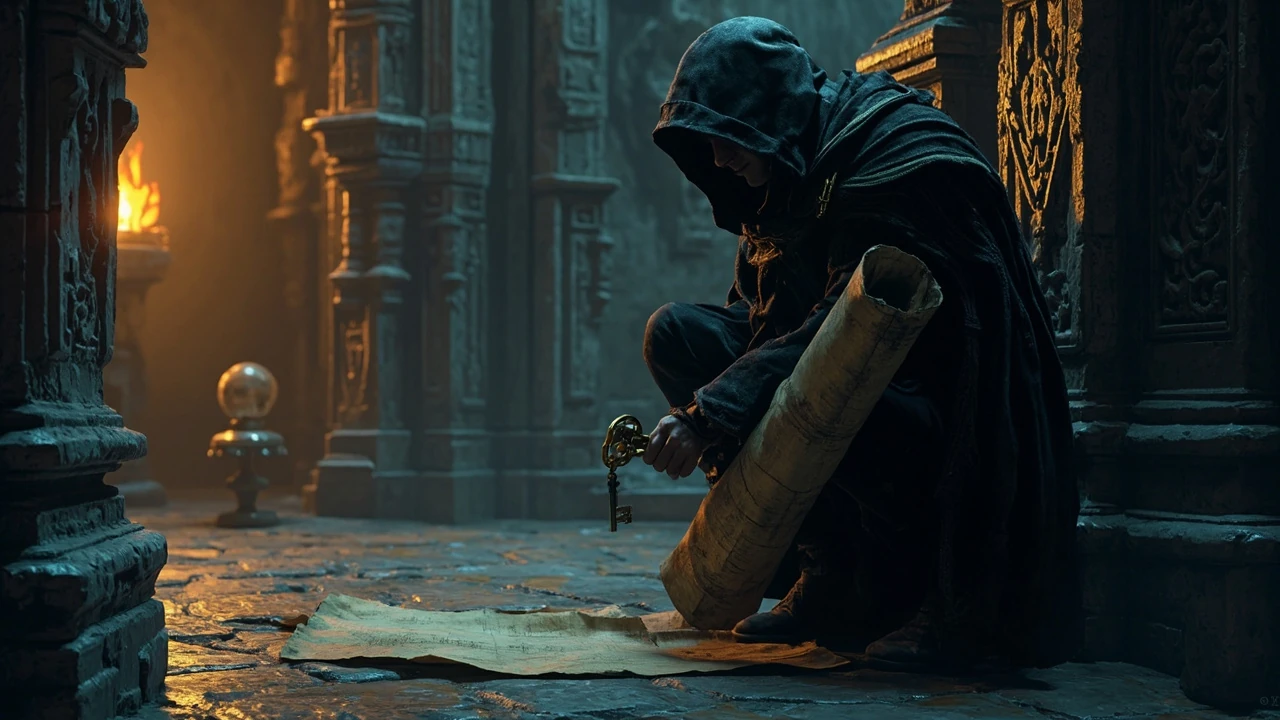
- The plan: a physical in-world document, the Plan for the Big Heist scroll, acts as the player’s design-level outline. If the player forgets the structure, the game offers a reminder they can read in their inventory.
This staged delivery is worth pausing on. Rather than dumping the quest steps into a journal entry, the designers hand the player a small set of verbs (jump, unlock, navigate) and a single readable artifact that re-describes the goal. The scroll is functionally a quest log, but it is diegetic. That decision influences pacing, attention, and the player’s sense that the world is reacting to them rather than the other way around.
The choice also has a second-order effect. Because the plan is stored as a physical item, a player who loses the scroll, drops it in the dungeon, or sells it accidentally has to recover it before the quest can continue. The quest does not break in that case, but the player’s reading of the artifact is no longer a free backstop. Small constraints like this are part of how older RPGs taught players to treat inventory as a working document rather than as a list of disposable gear.
Prerequisite design: why 1,000 gold and Boots of Springheel Jak matter
The two prerequisites for the quest are not arbitrary. Each one tests a different part of the player’s behaviour over the previous ten to fifteen hours of play.
The 1,000-coin fence requirement is an accumulation gate. The player must repeatedly find, steal, and successfully fence goods, which means engaging with the Thieves Guild’s day-to-day loop: pickpocketing, burglary, intercepting shipments, and using fences in different cities to convert stolen property into spendable gold. The number is high enough that it cannot be brute-forced by a single grinding session, but low enough that a player who is engaged with the faction will reach it naturally. From a design standpoint, the gate is a measure of system engagement rather than combat skill or level.
The Boots of Springheel Jak requirement is a memory gate. The boots are awarded in a quest that asks the player to find a legendary pair of footwear across several dungeons. The boots themselves grant a powerful jump bonus and silence the wearer’s landing, two effects that become useful but not strictly required later. By making the boots a quest reward and a prerequisite for the finale, the designers reinforce that this item matters beyond its immediate quest, and they reuse the jump mechanic as a core verb in the finale itself.
| Prerequisite | Type of gate | What it measures | What it teaches for the finale |
|---|---|---|---|
| Fence 1,000 gold of stolen property | Accumulation | Engagement with the theft loop | Confidence with pickpocketing, burglary, and fence economy |
| Complete Boots of Springheel Jak | Memory | Recall of a prior quest and an item | Familiarity with the boots’ jump and stealth effects |
| Wait in a major city until Amusei reappears | Time | Patience and world simulation awareness | The Thieves Guild operates on schedules, not instant triggers |
For designers, the lesson is that a faction finale can demand a layered set of competencies instead of a single number. The quest essentially performs a soft skill check across system familiarity, item awareness, and pacing, and it does so without a hard fail state. Players who meet the gates feel ready; players who do not, simply do not see the quest.
There is also a quieter effect. The wait condition forces the player to inhabit the world rather than fast-travel through it. A player who has just spent an hour running between cities will often sit down somewhere, rest, and let the day cycle advance. That downtime is not padding; it is the moment the game tells the player that the next step is about to begin. Designers who skip the wait condition in their own games often lose this small but useful buildup, and the finale loses some of its weight as a result.
The toolset: matching items to verbs
Once the player agrees to the job, three tools are handed over, and each one corresponds to a specific verb in the rest of the mission.
- Boots of Springheel Jak (returned): enable the player to reach a ledge that the default jump cannot. The verb is vertical traversal, and the verb was introduced in the boots’ original quest, so the player is not learning a new mechanic, only re-applying one.
- Arrow of Extrication: opens a door that no other key in the game can open. The verb is bypassing a hard barrier, and the item is single-use, which makes the moment feel costly.
- Imperial Sewer Key: grants access to an alternative route that bypasses the palace’s front entrance entirely. The verb is routing, giving the player a stealth path that the rest of the game does not require.
The pattern of one item per verb is a clean way to teach a small mechanical vocabulary in advance. By the time the player enters the palace, the verbs are not new. The map, however, is. That separation of known verbs, new layout is a common stealth design technique, because it lets the designers raise difficulty through route design rather than by introducing unfamiliar controls or systems.
It is worth noting that none of the three tools grant a combat advantage. There is no damage bonus, no enchanted weapon, and no spell scroll. The whole toolset is built around access and reach. This is unusual for a finale in a 2000s RPG, where the last mission of a faction often handed the player a signature weapon as a trophy. By stripping the tools down to access verbs, the designers force the moment of victory to come from the player’s reading of the level rather than from a stat check at the end. That decision alone places the heist closer to modern stealth design than to its contemporary peers.
Stealth systems and the Old Way
Stealth in Oblivion is governed by a detection model that responds to light level, line of sight, sound, and the player’s sneak skill. The Ultimate Heist leans on the most basic of these levers. The walkthrough recommends entering the Imperial City Palace at night to match the tone, but night also lowers light levels in the relevant interior, which reduces the detection radius of patrolling guards.
Once inside, the player reaches the Elder Council Chambers and is told to activate the Old Way using the Glass of Time. Activation is the trigger for the heist’s stealth phase. The quest then sends the player around a ring corridor to a basement door that must be picked, after which the player is in a space where, as the walkthrough phrases it, “you’re not supposed to be in.” From that point on, the player is expected to enter stealth and avoid being seen by guards.
From a design perspective, three things are happening at once:
- The detection model is being used as the central challenge rather than combat stats, which fits the Thieves Guild’s identity.
- The space is laid out as a continuous path with a single entry, which reduces the cognitive load of map navigation and keeps the player’s attention on enemy patrol lines.
- The quest assumes a baseline competence. It does not re-teach sneaking. Players who ignored stealth up to this point will feel underpowered, and that is intentional, because stealth is the faction’s defining verb.
The Old Way mechanic is also worth noting because it uses a single activation moment to lock the player into a stealth state. This is a common pattern in linear stealth design, sometimes called a “ghost protocol”: the moment the player crosses a line, the rules of the level change, and the only way out is to complete the objective without being detected or by recovering from a partial detection. The heist applies a soft version of this, because combat is still possible, but the design pressure clearly favours not engaging.
There is one more detail in the stealth setup that is easy to miss. The walkthrough describes the basement area as a place where the player is not supposed to be, which is a direct prompt to the player that detection has consequences. The designers are using the player’s own knowledge of the game’s social rules to set the stakes. The player already knows that guards arrest trespassers, so the designers do not need to add a new rule for this section. That kind of rule reuse is a small economy of explanation that makes the quest feel tightly written rather than padded with reminders.
Space and pacing: a single path through a large building
One of the more interesting choices in the quest is where it places the player: the Imperial City Palace, the most important interior in the game. The palace is normally a friendly space filled with political figures, guards, and court staff. Sending a thief through the same building changes the meaning of every corridor. Doors that were shortcuts in earlier quests now feel exposed. Guards that were ambient in the background become threats with line of sight.
To manage that scale, the designers route the player through a single direction: around the ring to the left, to the basement door, into a restricted area. There is no requirement to cross the building multiple times. The path is essentially A to B, with two branches introduced by the tools:
| Stage | Action | Tool used | Failure mode |
|---|---|---|---|
| Enter palace | Approach at night, lower detection | Boots (passive, reduced landing sound) | Daytime entry raises detection |
| Reach the basement | Follow ring corridor left, pick the lock | Lockpick skill | Failed lock leaves the door closed |
| Open the restricted door | Fire the Arrow of Extrication | Arrow of Extrication (single use) | Lost arrow blocks this path |
| Optional route | Use the Imperial Sewer Key for a stealthier entry | Imperial Sewer Key | Sewer route exposes the player to rats and water, but fewer guards |
Notice that every tool exists to remove a single barrier, not to give the player extra power in combat. The heist is not about being stronger. It is about being more precise. That is the entire identity of the Thieves Guild compressed into one quest.
The single-path design also has a production-side explanation. Reusing the palace saves level-design budget, because the corridors and rooms already exist. A smaller team can deliver a finale that feels like a new space simply by changing the rules under which the player moves through it. For studios working on long faction arcs with limited resources, the palace example is a useful case study in how reuse plus rule change can substitute for new geometry.
Why the quest is a strong teaching artifact for quest designers
There are several reasons the Ultimate Heist is often cited by designers and writers when discussing faction design. None of them depend on a single clever trick. They are the result of small, consistent decisions layered together.
- It respects prior content. The boots, the fence economy, and the Boots of Springheel Jak quest all matter again. Nothing is wasted.
- It teaches its mechanics in advance. The three tools are introduced before the player reaches the relevant obstacles, so the level reads as a vocabulary test rather than a vocabulary lesson.
- It changes the meaning of a familiar space. The palace is reused, but the player’s relationship to it changes. The building itself becomes a stealth level without any architectural change.
- It uses a diegetic quest log. The Plan for the Big Heist scroll functions as the player’s checklist, which keeps the player in the fiction.
- It trusts the player’s pacing. There is no timer in the stealth sequence, which lets players who have already learned the system feel rewarded for their investment.
For a team designing a long-form faction arc, the takeaway is that a finale does not need a new system to feel different. Reapplying the same systems in a more demanding space, with a small new vocabulary, can be enough.
It is also worth noting what the quest does not do. It does not introduce a new companion character with their own arc. It does not open a new region of the map. It does not give the player a new magic school. The finale is content in the strictest sense: the same verbs, the same tools, the same map, in a different arrangement. That is a discipline that many modern RPGs have lost, and it is one of the reasons the heist still reads as a model rather than as a museum piece.
How Oblivion Remastered affects the design conversation
Oblivion Remastered preserves the original quest structure but updates the visual layer and modernises the user interface. From a design standpoint, this is informative. A quest built on stealth, light levels, and a small item vocabulary is robust enough to survive a full visual overhaul, because its mechanics are tied to the simulation layer, not to specific button prompts or UI conventions. Designers working on a multi-platform release should note that the ultimate heist oblivion still plays the same way in the remastered version, even with updated graphics, lighting, and control schemes.
There is also a negative lesson. Any quest that depended on pixel-precise jumping on the original hardware is more forgiving on modern controllers and higher framerates. The Boots of Springheel Jak and the basement ledge in the palace benefit from this change. Designers who plan to remaster a stealth or platforming quest should test whether the geometry that defined the challenge is still appropriately demanding after a frame-rate or input-latency change.
A second consideration is modding. The original quest is widely modded, and the remastered version inherits that community. Designers studying the quest should expect players to alter the prerequisite thresholds, add new tool items, and rebalance the detection model. A quest that is mod-friendly tends to be one whose verbs are clearly separated from its values, and the heist is a good example of that separation in practice. The numbers can change without breaking the structure.
Common pitfalls when designing a heist quest
The Ultimate Heist avoids most of the failure modes common to stealth or heist content, but it is worth listing them so the trade-offs are explicit. Designers can use this list as a checklist when reviewing a similar quest in their own project.
- Explaining the verb in the level instead of before it. A heist that introduces a new gadget in the same room where the gadget is required is teaching and testing at the same time, which feels unfair to players.
- Overloading the player with inventory. Heist quests often hand out five or six items, then ask the player to remember which one fits each door. The Ultimate Heist gives three, and each is tied to one barrier.
- Stacking timers on stealth sections. Time pressure is a legitimate design tool, but stacking a stealth timer on top of detection pressure tends to push players into save-scumming. The Ultimate Heist has no timer in the stealth phase, which keeps the cognitive load on patrol reading rather than on the clock.
- Forgetting the faction identity. A heist that ends in a boss fight breaks the contract the player signed when joining a stealth faction. The Ultimate Heist resolves through stealth, dialogue, and object interaction, which is consistent with the Thieves Guild’s verbs.
- Letting the level be the same as every other dungeon. The palace is reused, but its meaning changes. Designers can apply the same trick to any reused location by shifting the player’s role in it.
- Underestimating the cost of the tool items. A heist that hands out infinite-use keys trivialises the moment. Single-use items, or items that return only after the finale, force the player to weigh when to commit.
Comparing the heist to other faction finales in the same generation
It is useful to place the quest against other faction finales of its era, because the design choices only become visible in contrast. A short comparison helps show what the Ultimate Heist is and what it deliberately is not.
| Faction finale | Defining verb | End state | Player role | Time pressure |
|---|---|---|---|---|
| Oblivion, Thieves Guild Ultimate Heist | Stealth and item use | Recover an Elder Scroll | Master thief | None in the stealth phase |
| Oblivion, Dark Brotherhood | Assassination and choice | Eliminate a named target | Professional killer | Limited dialogue choices |
| Other 2000s RPG faction finales, typical pattern | Combat and gear check | Defeat a faction boss | Warrior or mage | Optional timer in escort segments |
The contrast is not about which finale is better, but about the verbs each faction teaches. A player who finishes the Thieves Guild should feel like a thief. A player who finishes the Dark Brotherhood should feel like an assassin. A player who finishes a combat-focused guild should feel like a warrior. The Ultimate Heist, in particular, succeeds in part because the entire quest loop is shaped to reinforce the thief identity at every step, from prerequisite gates to toolset to the way the stealth phase ends.
A useful design exercise is to take a non-stealth faction finale and try to apply the same checklist: does it teach its verbs in advance, does it reuse a familiar space under new rules, does it use a diegetic log, does it avoid stacked timers, and does it resolve with the faction’s defining action? Most finales in the same generation would fail two or three of those tests, which is why the heist still stands out as a reference point.
Practical takeaways for designers and studios
For a working designer or studio, the practical questions are usually about implementation rather than theory. Here are the key design decisions to extract from this quest when planning or reviewing a similar mission.
- Define the verb set first. Decide the three or four things the player will do repeatedly, and design every obstacle around one of those verbs.
- Gate the finale behind the system it tests. A heist that does not require prior heist behaviour is just a stealth level with a coat of paint. Use accumulation or memory gates to ensure the player has already engaged with the relevant systems.
- Hand the tools to the player in advance. Items that appear at the moment they are needed feel scripted. Items that appear earlier feel earned.
- Reuse a known space and change its meaning. Sending the player through a familiar location under new rules is a cheap, effective way to raise tension without building a new level from scratch.
- Keep a diegetic quest log. A readable artifact in the player’s inventory serves the same purpose as a UI quest log, but it keeps the player inside the world.
- Avoid stacking timers on detection. Stealth already punishes mistakes. Adding a clock usually pushes players into reload loops rather than into the intended skill expression.
- Test after a remaster or platform change. Stealth and platforming geometry are sensitive to input latency, frame rate, and controller generation. Re-tune the margins after a port.
- Plan for modding from the start. Clear separation between verbs and values makes a quest easier to balance later, and it extends the life of the mission without extra work from the original team.
None of these decisions are unique to the Ultimate Heist, but the quest is a clean example of how a small set of consistent choices can produce a memorable finale. For studios working on long-form narrative content, the artefact is worth a focused study pass with the team.
One last point worth making is about team workflow. A finale like this one benefits from a single quest designer who owns the verb set end to end, rather than from a committee that hands off tools, gating, and level geometry to different people. The coherence of the heist is the result of one person’s view of the verbs, and that is hard to recover once a quest is split across disciplines. Studios that want to produce tighter finales should think about ownership, not just about tools.
Frequently asked questions
What quest unlocks the ultimate heist in Oblivion?
Boots of Springheel Jak is the prerequisite quest. The player must finish it and fence a total of 1,000 gold worth of stolen property before the finale appears. Until both conditions are met, Amusei will not offer the job, even if the player speaks to him in a major city.
Do I have to start the ultimate heist at night?
Night is strongly recommended in the published walkthrough because the lower light level reduces the detection radius of guards inside the palace. It is not a hard requirement, and players can enter during the day, but doing so makes the stealth section noticeably harder because the same patrols are easier to spot the player.
Where do I meet the Gray Fox to start the quest?
After Amusei directs the player, the meeting point is Othrelos’ House in the Elven Garden district of the Imperial City. The Gray Fox will give the player the Boots of Springheel Jak back, the Arrow of Extrication, the Imperial Sewer Key, and the Plan for the Big Heist scroll that summarises the mission.
What does the Arrow of Extrication do?
It opens a single locked door inside the palace that no standard key or lockpick can bypass. Because the arrow is consumed on use, the player only has one attempt at that particular shortcut, which makes the choice of when to fire it part of the stealth planning.
Can I complete the ultimate heist without the sewer key?
Yes. The Imperial Sewer Key opens an alternative route, but it is not strictly required. Players can proceed through the palace’s main basement door instead. The sewer route is a stealthier option for players who want to avoid guards, but it is one of several valid paths rather than a mandatory branch.
Is the ultimate heist different in Oblivion Remastered?
The core quest design, items, and gating remain the same in the remastered version. The visual layer, user interface, and performance targets are updated, and modern controllers make platforming segments such as the Springheel Jak ledge slightly more forgiving. The quest’s structure and pacing are preserved.
What skills should I level before attempting the quest?
Sneak is the most important skill, because the basement section assumes the player is in stealth for the majority of the route. A moderate lockpick skill is also useful for the basement door. Players who rely heavily on the sewer route will benefit from a small investment in Athletics to manage water traversal, although it is not a strict requirement.
Is there a time limit on the stealth section?
No. The quest does not impose a timer once the player enters the palace basement. The challenge is detection and patrol reading, not speed. This is one of the design choices that distinguishes the heist from a typical dungeon run.
Why is this quest considered a good design example?
It is a clean demonstration of a faction finale that reuses a familiar space, tests the player’s prior engagement with the faction’s verbs, and hands out the necessary tools in advance. The pacing is tight, the stealth model is the only real challenge, and the diegetic quest log keeps the player inside the fiction rather than relying on a UI checklist.
Leave a Reply