


Partnering with an iOS Game Development Company for Your Next Hit
Building a successful mobile game takes more than just a cool idea. The Apple App Store is crowded, competitive, and constantly changing. Every day, hundreds of new titles try to catch the eye of mobile players. Players expect smooth performance, crisp visuals, responsive touch feedback, and zero lag. Working with a dedicated iOS game development company helps turn early sketches and concept designs into polished digital experiences that stand out.
Game design on Apple hardware requires a clear understanding of ecosystem standards. Apple hardware is famous for high-speed processors, custom GPUs, high refresh rates, and tight security protocols. When you build specifically for iOS, your game can take full advantage of native frameworks like Metal graphics, Swift, and Game Controller APIs. That level of technical integration makes games feel snappy and look sharp.
Many indie creators and growing studios struggle to balance creative artwork with technical performance. Writing physics scripts while painting 3D character textures is a lot for a small team. That is where an experienced production partner steps in. Whether you want a 2D physics puzzle game, an idle clicker, or a massive 3D multiplayer world, choosing the right production partner makes all the difference.
What an iOS Game Development Company Brings to the Table
Every single step of game creation requires specialized skills. Artists design environments and characters, programmers write game logic, audio designers craft immersive soundscapes, and producers keep the project on schedule. An established studio brings all these disciplines together under one roof, working in harmony.
Building games completely in-house can quickly become expensive and complicated for new studios. Hiring full-time game engine programmers, level designers, technical animators, and QA testers requires significant capital and management bandwidth. A specialized production partner provides immediate access to seasoned talent without long recruitment cycles or expensive onboarding processes.
Production speed also improves dramatically when working with experienced developers. They already know how to handle memory management, metal shader optimization, App Store review guidelines, and in-app purchase setups. This deep practical knowledge prevents costly delays during Apple review submissions.
Here is what a complete game development partner delivers during full-cycle production:
- Full-cycle game design from initial concept art and mechanics prototyping to live operations.
- Custom graphics creation including 2D sprites, vector UI, 3D low-poly and high-poly models, and skeletal animations.
- Advanced physics engine integration, custom shaders, and dynamic particle effect customization.
- Comprehensive multiplayer networking, real-time matchmaking, and cloud backend server integration.
- Monetization strategy setup for rewarded video ads, subscriptions, battle passes, and microtransactions.
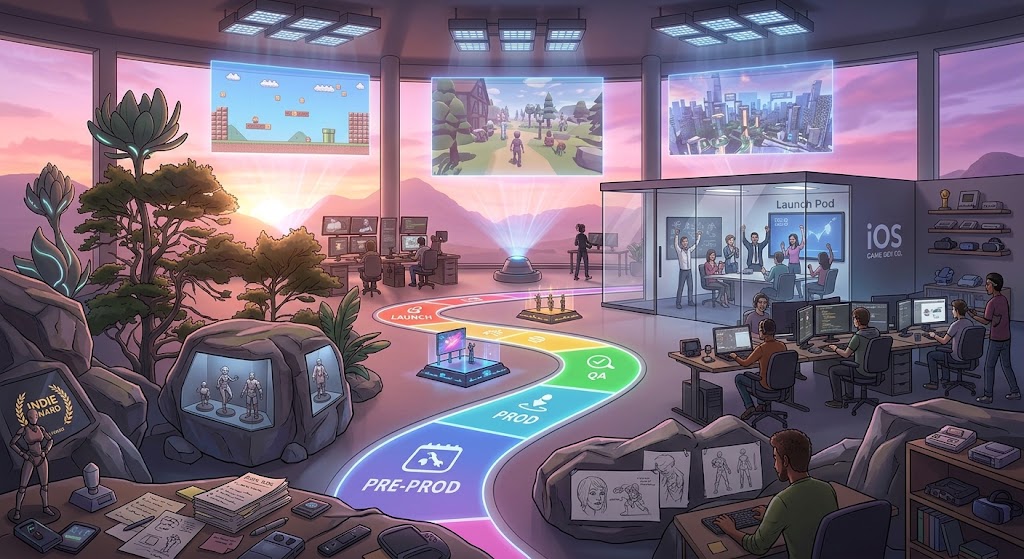
Here is how the game production lifecycle typically unfolds. Different stages require different resources and expertise, and knowing what to expect helps keep projects on budget and on schedule.
| Production Phase | Key Deliverables | Primary Team Members |
|---|---|---|
| Pre-Production | Game Design Document (GDD), Concept Art, Technical Specs, Engine Selection | Game Designer, Lead Architect, Art Director |
| Prototyping | Core Mechanics Graybox, Touch Control Layouts, Initial Physics Tests | Gameplay Programmer, UX Designer, Producer |
| Full Production | Playable Builds, 3D Assets, Engine Code, Audio Clips, VFX | Game Developers, 3D Animators, Sound Engineers |
| Testing & QA | Bug Reports, Performance Benchmarks, Device Compatibility Audits, Stress Tests | QA Engineers, Beta Testers, Security Analysts |
| Launch & LiveOps | App Store Package, Server Infrastructure, Content Updates, Analytics Dashboards | DevOps Engineer, LiveOps Manager, Community Lead |
And that is just the structural framework. Once pre-production is complete, development ramps up quickly across code, art, and sound. Everyone moves in sync toward key milestone builds.
Good communication keeps the entire creative engine running smoothly. Weekly playtests, video demos, sprint reviews, and transparent task tracking give you clear visibility into project progress. You always know what features are working, what mechanics feel fun, and what needs further polish.
Choosing the Right iOS Game Development Company for Your Project
Not every game studio fits every genre or art style. Some teams excel at casual hyper-casual arcade games, while others specialize in complex strategy games, simulation, or heavy narrative RPGs. You need to look closely at past portfolio projects before signing any production agreement.
Check the actual performance of games previously published by the studio. Download them and play them on real hardware. Look for quick loading times, responsive touch controls, intuitive user interfaces, and smooth frame rates. High frame rates on older iPhone models are a strong sign of quality engineering and deep optimization.
So, what technology tools power modern iOS game production? Apple offers several native tools, but third-party game engines remain extremely popular depending on project scope and multi-platform goals.
| Engine / Tool | Best For | Primary Strengths |
|---|---|---|
| Unity 3D | Cross-Platform 2D & 3D Games | Massive asset store, excellent physics, flexible C# scripting, wide community support |
| Unreal Engine | High-End High-Fidelity 3D Games | Photorealistic rendering, Nanite geometry, Blueprint visual scripting, advanced lighting |
| SpriteKit / SceneKit | Lightweight Native Apple Games | Zero third-party overhead, direct Metal access, minimal battery consumption |
| Godot Engine | Indie 2D & 3D Games | Lightweight footprint, open source, flexible node-based workflow, no license fees |
Selecting the right engine depends on your game mechanics, target file size, budget, and future expansion plans. Your engineering team can recommend the ideal framework early in pre-production based on your core gameplay goals.
Quality assurance forms another crucial leg of game creation. Mobile players leave bad reviews instantly if games crash, overheat phones, or drain battery too fast. Rigorous testing across various iPhone generations and iPad models prevents public relations headaches at launch.
Here are key testing phases every professional title must go through before public release:
- Automated stress testing for multiplayer network stability and server response times.
- Manual playtesting for gameplay loop balance, difficulty curves, and user retention.
- Frame rate stability checks on both flagship devices and older, budget-tier iOS hardware.
- Memory leak detection and thermal throttling audits to ensure long gaming sessions stay smooth.
Monetization strategy should also be planned from day one. You can offer a premium paid download, free-to-play with rewarded video ads, or seasonal battle pass subscriptions. Integrating Apple Pay and StoreKit properly ensures friction-free transactions for players across the globe.
Here are common monetization avenues for modern mobile titles:
- In-app purchases for cosmetic character skins, power-ups, extra lives, and virtual currency.
- Battle passes and seasonal subscriptions that encourage daily login habits and recurring revenue.
- Rewarded video ads that give players free in-game currency or extra turns in exchange for viewing.
Look at this simple truth: a great core gameplay loop keeps players coming back, but clean backend infrastructure keeps the game running without interruption. Multiplayer servers, global leaderboards, cloud saves, and anti-cheat protection must be robust from day one.
The mobile gaming market continues to grow rapidly across all demographics. Audiences demand fresh concepts, unique visual styles, and continuous content updates. Partnering with skilled creators lets you focus on building a strong community and brand, while experts handle the technical heavy lifting.
Frequently Asked Questions
How Much Does It Cost to Build a Mobile Game with an iOS Game Development Company?
Costs vary widely depending on the scope, visual style, and mechanics of your game concept. A simple 2D casual puzzle game or arcade title might cost between $20,000 and $50,000 to develop fully. Complex 3D multiplayer action games, strategy titles, or narrative RPGs can easily range from $100,000 to $500,000 or more. Key cost drivers include graphic fidelity, custom animations, backend server infrastructure, number of levels, and total production timeline.
How Long Does It Take to Develop an iPhone Game?
Development timelines depend heavily on project scope, art complexity, and team size. A straightforward 2D game typically takes 3 to 6 months from initial concept to public release. Mid-sized 3D titles usually require 6 to 12 months of steady production. Large multiplayer games with extensive live-ops roadmaps often take 12 to 18 months of development before initial soft launch testing.
Which Game Engine Is Best for iOS Game Development?
Unity is currently the most popular engine for mobile games due to its incredible versatility, large plugin ecosystem, and strong cross-platform support. Unreal Engine is preferred for high-end titles that demand photorealistic graphics and advanced visual effects. For lightweight native 2D games, Apple SpriteKit offers excellent battery efficiency and smooth performance with zero third-party software fees.
Will You Help Submit the Game to the Apple App Store?
Yes, professional development teams assist with the entire App Store submission process. This includes preparing store graphics, writing app descriptions, configuring StoreKit products, uploading signed build binaries, and addressing any reviewer feedback to ensure full compliance with Apple App Store Review Guidelines.
Who Owns the Intellectual Property and Source Code?
You retain 100% full ownership of all intellectual property, source code, visual assets, game design documents, and audio tracks once full project payments are completed. Professional contracts explicitly assign all creative and technical copyrights directly to your company.
Can You Upgrade an Existing Game to Support Newer iOS Versions?
Yes, development teams can modernize legacy games to run seamlessly on modern iOS releases and device screens. This process involves updating old code libraries, refactoring legacy code, adapting UI layouts for modern notch and dynamic island displays, fixing compatibility bugs, and updating native plugins.
How Do Post-Launch Maintenance and Content Updates Work?
Post-launch support usually operates on a retainer or dedicated monthly support contract. The production team handles bug fixing, OS compatibility updates, server monitoring, balance tweaks, and seasonal content drops to keep your active player base engaged long after initial release.
Creating a successful mobile title requires vision, technical discipline, and the right production team. By working with a reliable studio that understands the platform inside and out, you give your title the best possible chance to stand out and thrive in a competitive marketplace.
Leave a Reply