


Silksong Verdania: location, access, and what to expect
Verdania is one of the most discussed biomes players have associated with Hollow Knight: Silksong since the project was first revealed. The region has shown up in trailers, in early promotional material, and in developer commentary as a green, overgrown area with tall flora, hanging moss, and a quieter, more melancholy tone than the fungal caverns or industrial zones the series is known for. Because Silksong has spent years in development and the studio has been careful with what it confirms, the public picture of Verdania is a mix of verified on-screen appearances, developer statements, and careful community reading of the same material. This page sorts those threads into one practical guide: where the area fits, how it has been presented, what the official art and trailers actually show, and how a player should think about it before release.
The goal here is not to leak or speculate beyond what is public. It is to give a player who is following Silksong a single, organized reference for everything that has been said or shown about Verdania, with the gaps clearly marked. Where a detail is confirmed in an official source, it is stated as fact. Where a detail is inferred from a single trailer frame or from older developer comments, the source and the limits of that inference are called out. The same approach applies to game design details: anything that is not yet verifiable, such as exact boss behavior or the order of the region on the map, is left as a question rather than dressed up as confirmed knowledge.
What Verdania is in the context of Silksong
Verdania has been described in Silksong coverage as a mossy, overgrown region with a strong vertical feel, tall trees, and a heavy emphasis on organic shapes. The Hollow Knight franchise is built around distinct biomes, each with its own palette, enemy set, music, and traversal challenges, so a region like Verdania carries more weight than simply being a forest level. It is meant to feel different from the fungal zones, the hive, the city of tears, and the crystal peak, both in look and in how Hornet moves through it.
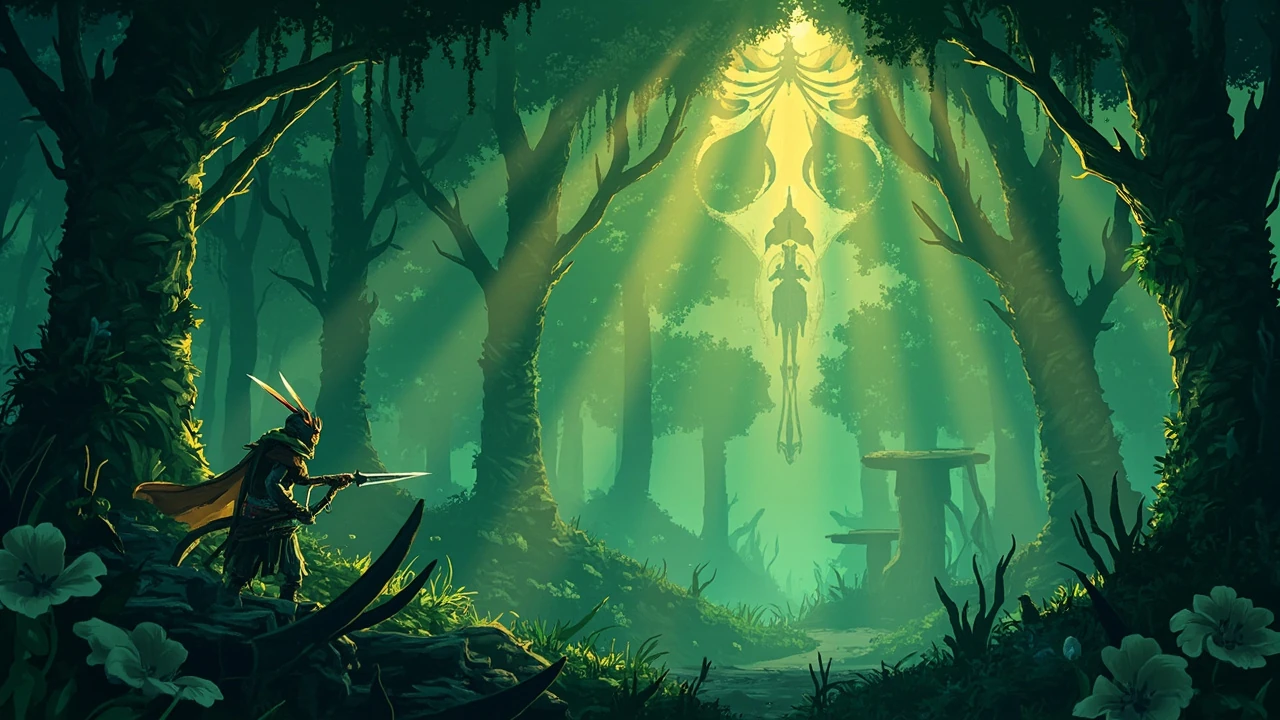
The visual language that has been associated with Verdania leans toward green and gold, with pale flowers, hanging moss, and a softer, more diffuse lighting than the underground or industrial areas in the game. In the original Hollow Knight, the Forgotten Crossroads, Greenpath, and the Royal Waterways each played a different role in the player’s progression. Greenpath was the first region that introduced moss, vines, and the Mosskin as a slower, plant-based threat. Verdania appears to push that plant-and-moss idea further, with a more developed canopy and a more clearly defined sense of place.
For a player who is following Silksong, the practical question is not just “what does it look like” but “where does it sit in the game.” That question is harder to answer cleanly because the map layout, the order of regions, and the exact prerequisites for reaching Verdania have not been spelled out in detail by Team Cherry. The best a guide can do is describe the evidence, name what has been shown, and flag what still needs confirmation.
Where Verdania fits in the Silksong map
Silksong’s map is built around the kingdom of Pharloom, a new setting that sits above and around a central citadel, with a range of biomes radiating outward. The kingdom is presented as a more vertical and politically organized place than Hallownest, which means regions are described both by environment and by who lives there. Verdania is associated with the green, mossy band of Pharloom, and it has been shown in the same general neighborhood as shell-and-moss themed architecture in early concept material.
From a progression standpoint, regions in this style of game tend to be reachable only after certain traversal tools are unlocked. In Hollow Knight, the Mantis Claw, the Monarch Wings, the Isma’s Tear, and the Crystal Heart each opened a new chunk of the map. Silksong has already shown several new tools for Hornet, including a silk-based dash, a longer-range needle, and a downward strike. The combination of those tools with the platforming in a region like Verdania is what gives the area its difficulty, and it is the reason a guide cannot simply say “go north from the start and you will find it.”
The honest answer to “where is Verdania” is that it is one of the named regions of Pharloom, that it has been shown in the same vertical band as the mossy, green, forest-like areas of the map, and that the specific path to it will depend on the order Team Cherry chose for the regions. Until the studio publishes a map, or players get to explore the finished game, the position of Verdania on the final route should be treated as unverified.
How access to Verdania has been shown in trailers
Several official Silksong trailers and gameplay showcases have included shots that the community has labeled as Verdania. These shots share a consistent visual language: a green canopy, a soft golden light, tall thin tree-like structures, and a sense of height that the player can climb through. Hornet is usually shown in these scenes either suspended on a thread, leaping between platforms, or in the foreground with the canopy stretching behind her.
What those trailers actually confirm is limited, and it is worth being explicit about it. They confirm that the region exists in the final game, that it has the visual identity described above, and that it is built for vertical movement with Hornet’s kit. They do not confirm the exact access point, the prerequisites for reaching it, or the bosses and NPCs that live there. Some of the same trailer footage has also been reused, edited, or re-colored in different showcases, which means a single frame is not always proof of a final feature.
For a careful reader, the right way to treat trailer footage is as a window into art direction and tone, not as a gameplay manual. The colors, the shape of the platforms, and the way the light falls are reliable. The exact enemy placements, the order of rooms, and the quest hooks that lead into the region are not reliable until the game is in players’ hands and those details have been verified by enough independent playthroughs to rule out early-build artifacts.
Why a green, mossy biome matters to Silksong’s design
The series built by Team Cherry, documented in depth on Wikipedia, uses biomes to teach the player new movement and combat ideas. Greenpath in the first game was where many players met the Mosskin for the first time, learned to deal with spore clouds, and started to get comfortable with the pacing of larger rooms. A sequel needs new regions to teach the same lessons with new tools, and Verdania looks like it has been built with that role in mind.
The plant and moss theme gives designers a natural vocabulary for traps and movement. Vines can be platforms, roots can break under the player’s weight, hanging moss can hide enemies or reward exploration, and pollen or spore effects can add a status layer to combat. Combined with Hornet’s silk abilities, that vocabulary produces a region where the player is asked to swing, cling, and strike downward as much as they are asked to dodge and parry.
There is also a tonal reason to have a green region. Silksong’s Pharloom is presented as a more organized, citadel-driven kingdom than Hallownest, with a clear sense of pilgrimage and industry. A mossy, overgrown region stands in contrast to that: it reads as older, quieter, and less governed. That contrast is useful storytelling, because it gives the player a place to slow down, to find NPCs who are not part of the central plot, and to feel the world breathing before the next major story beat.
Trailer evidence and what it actually shows
The strongest trailer evidence for Verdania comes from the gameplay showcase material that Team Cherry has released, including footage that has been re-cut and re-shown across multiple events. A reader who wants to track the region should look for a few consistent features across those clips:
- A green and gold palette, with hanging moss or vine-like decorations in the foreground.
- Tall, thin vertical structures that read as trees or stalks, layered into the background to give a sense of canopy depth.
- Platforms that are wider at the base and narrower at the top, suggesting paths that climb into the canopy rather than across a flat floor.
- Hornet shown using silk abilities, including the long dash and what appears to be a downward strike, in the same shots as the foliage.
- One or more larger creatures or NPCs placed deep in the background, hinting at bosses or named characters that inhabit the area.
Each of those points is a visual reading, not a confirmed gameplay mechanic. A pale, glowing shape in the background could be a friendly NPC, a passive creature, or a boss arena entrance. The same is true for the platforms: a wide, flat shape could be a save point, a bench, a shop, or simply a level-design choice for that particular shot. The right way to read a trailer is to note the features, hold them as candidates, and wait for verification in the shipping game.
Developer commentary on the region
Team Cherry has spoken about Silksong in interviews and in short developer notes over the years. When they have mentioned regions, the language has been careful: they tend to describe the feel of a place, the type of enemy, or the kind of traversal challenge, rather than revealing map layout or progression order. For Verdania specifically, the public commentary has been in line with that style.
Where the studio has been clearer is on the broader design intent. They have talked about wanting each region in Silksong to feel like its own place, with its own cast, music, and pace, and to avoid the “more of the same” feeling that longer sequels can fall into. A region like Verdania, with its strong color and theme, fits that intent well. It is a place the studio can use to slow the game down, introduce a quieter NPC or two, and give the player a moment of breathing room in the middle of the map.
The practical takeaway from developer commentary is that Verdania is meant to be a meaningful stop, not a corridor. Players who reach it should expect a self-contained set of rooms, a distinctive enemy roster, and a reason to explore the area rather than pass through it. The exact reward structure, the items that can be found there, and the quest that ties the region to the wider plot are not part of the public record yet, and any guide that claims otherwise is overreaching.
What players should verify before trusting a Verdania guide
Because the game has been in development for a long time, there is a large amount of community material about Silksong on the internet, and not all of it has been kept up to date. A player looking for practical Verdania advice should treat any guide written before the game’s release as speculative, even if it is written in the present tense. The safest approach is to check a few simple things before trusting the detail:
- Date of writing: a guide written before release cannot confirm what is in the shipping game, only what was shown or stated at the time.
- Source of claims: a detail traced to an official trailer, a developer interview, or a press kit is more reliable than a detail traced to a forum post or a YouTube thumbnail.
- Whether the detail has changed: areas, names, and even regions have been adjusted during development, and older screenshots may not match the final build.
- Whether the detail is mechanical or cosmetic: a confirmed color palette is more stable than a confirmed boss order, because the latter can change with difficulty tuning and pacing.
That same caution applies to older build leaks. Even when footage appears to be in-engine, an early build can have placeholder art, missing audio, and partially implemented systems. A region that looks finished in a 2021 build may have had its layout changed significantly before release, and bosses that appeared in that build may have been reworked or removed entirely.
How Verdania compares to other Silksong regions
The reference page that tracks what has been officially shown of Silksong puts Verdania at the greener, more open end of the map, alongside the citadel, the darker caverns, and the industrial areas. The two tables below summarize how the regions have been presented in official material. The first table compares visual and tonal identity, and the second lists the kind of traversal challenges each region seems built around. Both are working readings, not progression order, because the order has not been publicly confirmed.
| Region | Visual identity | Tonal role | Lighting feel |
|---|---|---|---|
| Verdania | Green canopy, hanging moss, pale flowers, soft gold light | Quieter, older, more contemplative space within Pharloom | Soft, warm, diffuse daylight filtered through leaves |
| Citadel and surrounding shell | Stone, brass, banners, organized architecture | Political center, the kingdom’s seat of power | Even, slightly cool interior lighting |
| Greymoor and darker caverns | Low light, rock, mineral tones, tighter tunnels | Pressure and danger, places the kingdom would rather leave alone | Dim, scattered, with deep shadows |
| Industrial and bell-themed areas | Metal, heat, mechanical parts, industrial palette | Industry and pilgrimage, the working side of Pharloom | Harsh, warm, with sparks and machinery glare |
| Region | Likely traversal flavor | Combat texture | Probable mechanical hook |
|---|---|---|---|
| Verdania | Vertical platforming with silk, climbing, downward strikes | Swinging, mid-air needle work, reading layered arenas | Vines, moss platforms, and canopy-based navigation |
| Citadel and surrounding shell | Long corridors, stairways, structured rooms | Disciplined parry-and-strike pacing | Banners, lifts, and processional spaces tied to the central plot |
| Greymoor and darker caverns | Smaller rooms, tighter tunnels, fewer long swings | Close-quarters combat, cautious spacing | Mineral hazards and tight sight lines |
| Industrial and bell-themed areas | Timing-based obstacles, hazards tied to machinery | Reactive dodging around moving parts | Bells, pistons, and timed mechanisms |
Both tables are a working reading, not a finished taxonomy. If Team Cherry reorganizes the regions or renames any of them before release, the comparison will need to be updated. It is still useful as a way to think about why a green, mossy region matters: it provides a different color, a different pacing, and a different set of challenges from the rest of the map.
Predicted traversal and combat flavor in Verdania
It is possible to make measured predictions about how a region like Verdania will play, even without confirmed mechanics, because Hollow Knight’s combat and traversal systems are well documented and Silksong’s additions have been shown clearly. The predictions below are framed as “given the visual identity and the kit, the region is likely to lean on these ideas,” not as confirmed features.
- Vertical movement: tall trees and hanging moss suggest a region where climbing and long drops are the norm, and where silk-based movement is at its most useful.
- Mid-air combat: spaces with gaps between platforms reward attacks that can be used in the air, which fits Hornet’s needle and the downward strike shown in trailers.
- Environmental hazards: moss, vines, and pollen are natural candidates for slow debuffs, blind effects, or movement-altering zones that the player has to read carefully.
- Quiet NPC encounters: a contemplative region is a good place for a healer, a bench-keeper, or a quest-giver who is not part of the main plot, echoing the role of characters like the Greenpath Elder or the Seer in the first game.
- Boss design that uses the canopy: large creatures that occupy the vertical space, fight in layered arenas, or change the environment as the fight progresses would fit the visual language that has been shown.
None of those predictions are confirmed. They are the kind of mechanics that fit the region’s identity, and they are useful when thinking about what to expect, but they should not be quoted as features until the game is in players’ hands.
What the music and audio of Verdania is likely to emphasize
Music is a major part of how Hollow Knight’s biomes are remembered. Greenpath, the City of Tears, and the Deepnest each have a sound that is tied to their environment, and Silksong’s composers have continued that approach. For a green, mossy region, the audio palette has historically leaned on woodwinds, soft strings, and organic textures, with ambient layers that suggest wind, water, and small creatures. A region like Verdania would fit that pattern, with a slightly more developed sense of place because Pharloom is presented as a more traveled world than Hallownest.
The Hollow Knight series has also used audio cues to teach mechanics. The rustle of moss, the hum of a bell, the click of a deepnest crawler, and the chime of a soul totem each signal something to the player. A mossy, contemplative region can use softer cues: the sound of a vine giving way, a distant call from a creature in the canopy, or a shift in the ambient track as the player enters a new sub-area. Those cues are subtle, and they are part of why a guide written before release tends to underplay how the region will actually feel in motion.
How fans have organized their notes on Verdania
The Silksong community has spent years cataloging every official screenshot, trailer frame, and developer comment. For a region like Verdania, that work has produced a small, useful body of shared notes. A player who wants to follow along can use that catalog as a starting point, with the same caveat that applies to any pre-release source: it is a reading of the evidence, not a description of the final game.
Community notes have generally converged on a few points. The region is green, vertical, and tied to moss and vine imagery. Hornet’s silk kit is shown in the same scenes as the foliage. The lighting in those scenes is soft and warm, which separates Verdania from darker, more enclosed biomes. There is at least one larger creature or NPC placed in the background of the same shots, which suggests a named character or boss. None of those observations are disputed; the disagreement tends to be about what each observation implies, and about whether older build footage is representative of the shipping game.
What a player can do before the game is out
For a player who wants to be ready for Verdania without overinvesting in speculation, the practical steps are simple. The list below is meant to keep the focus on verifiable information and avoid the trap of learning a build of the game that does not exist yet.
- Watch the most recent official trailer and gameplay showcase, and note the color, lighting, and platforming cues rather than the enemies or names.
- Read recent developer interviews for language about biomes, pacing, and traversal, without treating any single comment as a map guarantee.
- Avoid pre-release maps, boss lists, and route guides, because they are the most likely to be wrong and the hardest to unlearn once the game is out.
- Keep a small list of confirmed items: the new tools Hornet has been shown using, the basic enemy archetypes that have been shown, and the regions that have been named in official material.
- Decide in advance which version of the game to play on launch, so the platform decision does not get tangled up with the exploration decision.
That list is small on purpose. The point is to keep the pre-release preparation proportional to the information that is actually public, and to save the deeper learning for the game itself.
What changes once Silksong is released
Once the game is in players’ hands, the role of a guide like this changes. Speculation gets replaced by verified details, the trailer footage can be cross-referenced against the final build, and the community catalog starts to settle into a stable shape. The same general advice applies to Verdania as to any region in the game: trust the patch notes, trust the in-game map, and trust the consistent reports from a wide range of players over the first few weeks. The information that survives that period is the information worth keeping.
For the launch window, the most useful thing a player can do is keep notes. The location of benches, the order of boss arenas, the prerequisites for accessing Verdania, and the items that are easiest to miss are all details that are easier to capture once and refer back to than to re-learn each time. That habit is also what makes a written guide valuable: it is a record of what the game actually is, not what it was rumored to be.
Frequently asked questions
What is Verdania in Silksong?
Verdania is one of the named regions in Hollow Knight: Silksong. It has been presented in official trailers and promotional material as a green, mossy area with tall trees, hanging foliage, and a strong vertical feel. It is part of the kingdom of Pharloom, the new setting for Silksong, and it reads visually as a more contemplative, plant-themed space compared with the citadel and industrial regions of the map.
Where does Verdania fit on the Silksong map?
Verdania has been shown in the same band of Pharloom as the mossy, green environments of the game. The exact position on the map, the prerequisites for reaching it, and the order in which a player is expected to visit it have not been published in detail by Team Cherry. Treat any pre-release map or route that places Verdania in a specific slot as speculative until the studio confirms the layout or the game is in players’ hands.
How do you access Verdania in Silksong?
Access to Verdania has not been described in a step-by-step official guide. In a game of this style, regions are usually reached by combining traversal tools with map exploration, and Silksong has shown Hornet with new silk-based abilities that are likely to be part of the access puzzle. Until the game is released, any specific access route should be treated as a community reading rather than a confirmed path.
Is Verdania confirmed to be in the final game?
Verdania has been shown in multiple official trailers and gameplay showcases for Silksong, and the region’s name has been used in the same official material. That level of presence in the studio’s own marketing makes it very likely to be in the final game, but the only fully reliable confirmation is the shipping release. Until then, “very likely based on official footage” is the most accurate framing.
What kind of enemies and bosses are in Verdania?
No specific enemy or boss roster for Verdania has been confirmed in an official, detailed way. The trailer footage associated with the region suggests at least one larger creature or named character in the background, and the moss and vine theme points to plant-based enemies, but the exact list, the boss order, and the difficulty of each encounter are not part of the public record yet.
Does Verdania look like Greenpath from the first Hollow Knight?
Verdania shares a mossy, plant-based visual language with Greenpath, but it is a different region in a different kingdom. The scale in the trailer shots looks larger and more vertical, the canopy is more developed, and the lighting is softer and warmer. A player who liked Greenpath’s tone will probably enjoy Verdania, but the region is its own space rather than a re-skin.
Will Verdania be required for the main story?
Whether Verdania is a required stop or an optional one has not been confirmed. Hollow Knight’s design lets many regions be explored in different orders, and Silksong has been described in similar terms. A safer assumption is that Verdania will be useful for items, abilities, or lore, and that it may or may not be required for the main ending, depending on how the studio has set the quest hooks.
Should I avoid pre-release Verdania guides?
Pre-release guides are best treated as a record of what was shown or speculated at the time of writing, not as a description of the final game. They are useful for tracking the visual identity of the region and the language Team Cherry has used, but they are not a reliable source for access routes, boss order, or item locations. A guide written before release cannot know what changed during the final stages of development, and the safest approach is to verify each detail against the shipping game or against a wide range of post-release reports.
What is the music style of Verdania likely to be?
Based on the visual identity and on the series’ history, Verdania is likely to use organic, softer instrumentation, with woodwinds, strings, and ambient layers that suggest wind, moss, and small creatures. The Hollow Knight series uses music to set the tone of each biome, and a contemplative green region fits that approach. The exact tracks have not been previewed in detail, and the final recording will be the only reliable source.
How can I stay up to date on Verdania news?
The most reliable sources for Verdania news are Team Cherry’s own channels, including the studio’s official site, its announcements, and the trailers it publishes on its own pages. Reputable press outlets will pick those announcements up, and the wider community will discuss them, but the studio’s own statements are the source that should be checked first.
Leave a Reply