

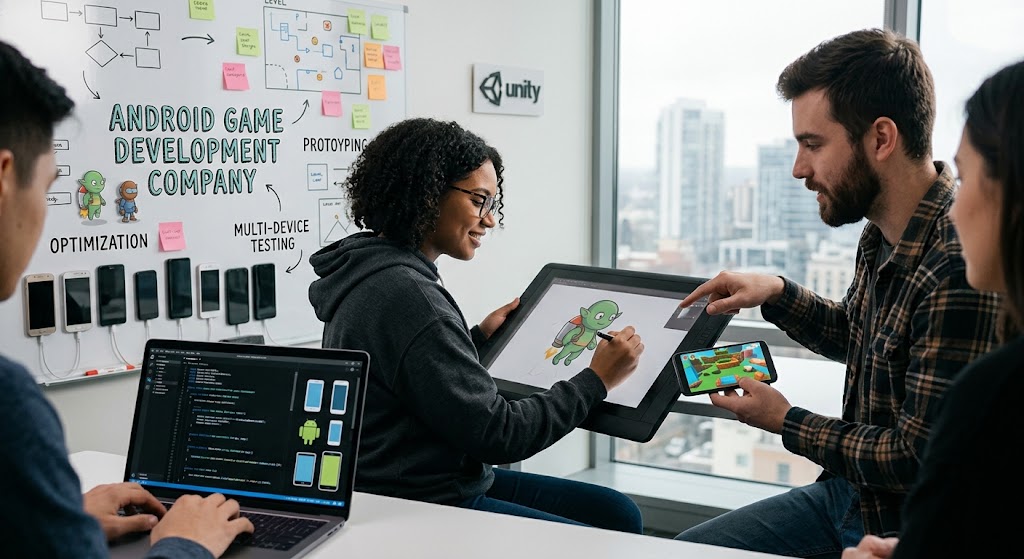

What An Android Game Development Company Can Do For Your Vision
Building a great mobile game takes more than just a fun idea written on a napkin. You need smooth graphics, tight controls, balanced mechanics, and stable code that works across thousands of different devices.
That is where a specialized team comes into play. Android holds the biggest market share in global mobile gaming. But reaching that audience means dealing with endless screen sizes, chipsets, and operating system updates.
Partnering with an experienced android game development company helps you skip common mistakes. You get direct access to designers, programmers, artists, and sound engineers who already know how to optimize performance.
So, how do you go from a simple concept to a polished title on Google Play? Let us walk through how professional studios bring mobile games to life, what it costs, and how to pick the right team for your project.
Why Mobile Game Production Demands Specialized Expertise
Creating a mobile game is fundamentally different from building a regular enterprise app. Games rely heavily on real-time rendering, physics engines, user input latency, and audio management.
And Android devices present unique challenges. A game that runs smoothly on a flagship phone might stutter or crash on an entry-level device sold in emerging markets.
An android game development company understands these hardware variations deeply. They design assets and write code specifically to keep frame rates consistent across screen resolutions and hardware tiers.
Here is why technical expertise matters for your mobile game project:
- Device fragmentation management across thousands of active smartphone models
- Memory optimization to prevent crashes on lower-end devices
- Battery draw reduction so players can enjoy longer sessions without overheating
- Custom shader writing and graphics tweaking for mobile GPUs
- Smooth integration of monetization SDKs, ads, and in-app purchase systems
Without proper optimization, players leave quick single-star reviews and uninstall your app within minutes. High technical quality protects your launch investment and drives user retention.
Core Services Offered By An Android Game Development Company
Full-service mobile game studios offer end-to-end production capabilities. You can hire an android game development company to handle your entire project from start to finish or plug their specialists into your existing team.
Most studios split their production work into clearly defined phases. This structure keeps budgets predictable and milestones accountable.
Services Provided By An Android Game Development Company
When you sign a contract with a professional studio, you get access to a full cross-functional team. They cover every technical and creative discipline required for a commercial release.
Here is a breakdown of the standard services offered during production:
| Service Area | Key Deliverables | Primary Focus |
|---|---|---|
| Game Design & Prototyping | Game Design Document (GDD), playable mechanics prototype, level blockouts | Fun factor, player progression, core loop validation |
| 2D & 3D Asset Creation | Character models, environment art, UI icons, animations, visual effects | Visual identity, artistic consistency, asset performance |
| Software Engineering | Engine code, gameplay logic, networking scripts, backend database integration | Performance, bug-free execution, scale support |
| Quality Assurance | Test matrices, automated regression scripts, manual playtesting logs | Bug detection, hardware compatibility, stability checks |
| Live Operations Support | Content updates, balance patches, event management, server maintenance | Long-term player retention, post-launch monetization |
Each phase requires clear communication between your product lead and the studio team. Regular sprint reviews ensure that the game stays true to your creative vision.
Good studios also help with store submission guidelines. Google Play has strict security, privacy, and content rules that must be followed to avoid launch delays.
Understanding The Tech Stack For Android Gaming
Choosing the right game engine is one of the most critical decisions in early planning. The engine determines your development speed, performance potential, and team scalability.
An established android game development company will guide you toward the software stack that best fits your game mechanics and visual complexity.
Let us look at the most popular game engines used across the industry today:
| Game Engine | Best For | Programming Language | Key Strengths |
|---|---|---|---|
| Unity | 2D & 3D cross-platform games, casual to mid-core titles | C# | Vast asset store, massive talent pool, lightweight build size |
| Unreal Engine | High-fidelity 3D graphics, realistic action games | C++ / Blueprints | Photorealistic rendering, robust visual scripting, advanced physics |
| Godot | Lightweight 2D titles, indie projects, custom games | GDScript / C# | Open source, extremely fast load times, zero licensing fees |
| Native Android (Java/Kotlin) | Simple 2D puzzles, utility games, lightweight card games | Kotlin / Java | Minimal footprint, direct OS integration, maximum control |
Unity remains the default choice for an android game development company. It balances rich visual features with excellent mobile optimization tools.
Unreal Engine shines when you are targeting high-end graphics on modern devices. But it requires experienced programmers to keep memory footprints low on older smartphones.
Key Stages Of Mobile Game Development
Every successful game follows a structured lifecycle. Skipping steps to rush to market almost always leads to broken mechanics or bad reviews.
Here is how a standard production timeline flows from initial concept to launch:
1. Pre-Production And Concept Validation
Before writing code or drawing final assets, the android game development company tests concepts. Designers draft the core gameplay loop and document player goals, rewards, and controls.
Developers create quick grey-box prototypes to feel out movement and interaction. If the basic mechanic is not fun with simple blocks, fancy graphics will not save it.
This stage produces the core Game Design Document. It acts as the blueprint for the entire project, defining scope, art direction, and monetization strategy.
2. Production And Asset Creation
Once the prototype is approved, full-scale production begins. Programmers build gameplay systems, UI, inventory mechanics, and backend networking.
Artists craft character models, environments, particle effects, and animations. Sound engineers compose background tracks and record clear audio cues for player actions.
Development happens in iterative cycles, usually two-week sprints. You can test new builds regularly and review progress against planned milestones with your android game development company.
3. Quality Assurance And Device Testing
Quality assurance runs throughout production, but intensifies before release. QA testers push the game to its limits to find edge-case bugs and performance drops.
Testing on real Android devices is essential. Emulators are great for quick checks, but they cannot replicate real battery drain, memory pressure, or touch latency.
This phase also includes security checks for in-app purchases and user account protection. Nobody wants exploiters ruining the game economy on day one.
4. Soft Launch And Global Release
Smart developers release their game in selected regional markets before launching worldwide. This soft launch provides real player data without exposing the title to your full market audience.
You can measure day-1, day-7, and day-30 retention rates during soft launch. It also helps test server stability and optimize ad placement under real player traffic.
Once key performance indicators meet target metrics, the game launches globally on Google Play. Marketing campaigns turn on, and live operations take over.
Monetization Models For Mobile Games
A brilliant game still needs a solid business model to turn a profit. Mobile gaming offers several proven revenue approaches depending on your genre and target audience.
Here are the primary ways to monetize your mobile game:
- Free-to-Play with In-App Purchases (cosmetic skins, battle passes, consumable items)
- In-Game Advertising (rewarded video ads, interstitial banners, native ads)
- Premium / Paid Downloads (one-time upfront purchase price)
- Subscription Models (recurring monthly access to exclusive content and perks)
- Hybrid Monetization (combining rewarded ads with optional in-app purchases)
Hybrid monetization currently leads the market in revenue generation. Giving non-paying users a way to progress by watching rewarded ads keeps retention high while monetization scales.
Your android game development company should design monetization mechanics into the core gameplay from day one. Tacking store systems onto a finished game almost always feels forced and annoys players.
How To Choose An Android Game Development Company
Selecting the right development partner is the single biggest factor in your project’s success. You need a studio that communicates clearly, respects budgets, and delivers quality code.
Do not just look at flashy art samples. You need to verify technical competence, past market performance, and client references.
How An Android Game Development Company Delivers Results
When reviewing potential partners, ask targeted questions to gauge their actual production experience. Look for teams that have shipped titles similar to what you want to build.
Here is a helpful checklist to guide your decision-making process when vetting an android game development company:
- Portfolio Quality: Have they published games on Google Play with strong user ratings and good downloads?
- Engine Mastery: Does their engineering team have proven experience in Unity, Unreal Engine, or native development?
- Communication Rigor: Do they offer clear project management pipelines, daily updates, and transparent reporting?
- Post-Launch Commitment: Can they support live operations, bug fixes, and seasonal content updates after release?
- IP Rights Ownership: Do you retain full rights to source code, visual assets, audio, and branding?
Ask for client references and reach out to past partners. Hearing about how an android game development company handles tight deadlines will tell you more than any pitch deck.
Look at code architecture as well. Clean, modular code makes future updates easier and cheaper when you expand the game post-launch.
Cost Factors In Mobile Game Production
How much does it cost to build a mobile game? The honest answer is that it depends entirely on scope, visual complexity, and backend demands.
A simple 2D puzzle game might cost $15,000 to $35,000. A complex 3D multiplayer action title can easily exceed $150,000 to $500,000+.
Key variables that influence your final budget include art style, engine choice, server architecture, and team location.
Art assets take up a major portion of game budgets. Original 3D character models, custom animations, and complex environment sets require hundreds of design hours from an android game development company.
Backend infrastructure also scales costs. If your game features real-time multiplayer, global leaderboards, or active matchmaking, cloud server setup and maintenance will add ongoing operational expenses.
Outsourcing to offshore or nearshore teams at an android game development company can lower hourly rates without sacrificing technical quality. Many top mobile titles are built by distributed teams across Eastern Europe, Asia, and Latin America.
Future Trends In Mobile Gaming Development
Mobile hardware keeps evolving fast. Today’s smartphones rival the processing power of previous-generation gaming consoles.
This rapid hardware growth opens up exciting possibilities for game designers and developers. Working with a forward-thinking android game development company ensures your game remains relevant in a competitive marketplace.
Cross-platform play is becoming standard. Players want to log into their game accounts on Android, iOS, and PC seamlessly without losing progression.
Cloud gaming and dynamic asset streaming are reducing install sizes. This lets players start playing complex games in seconds while high-resolution assets download in the background.
Artificial intelligence is expanding as well. An android game development company can use AI for smarter NPC pathfinding, procedural level generation, and localized automated testing during production.
By leveraging these emerging technologies, progressive studios build games that capture attention, keep players hooked, and deliver sustainable revenue growth.
Frequently Asked Questions
What Does An Android Game Development Company Do?
An android game development company designs, codes, tests, and launches mobile games for Google Play. They provide full-cycle services including art creation, programming, quality assurance, sound design, and post-launch maintenance.
How Long Does It Take To Develop A Mobile Game?
Simple 2D casual games usually take 3 to 6 months to complete. Medium-complexity titles take 6 to 12 months, while large 3D multiplayer games can take 12 to 24 months or more from initial concept to launch.
Which Game Engine Is Best For Mobile Games?
Unity is generally considered the best all-around engine for mobile game development due to its flexibility, efficient performance, and extensive asset library. Unreal Engine is preferred for high-end 3D graphics, while Godot is great for lightweight 2D titles.
How Much Does It Cost To Hire A Game Development Studio?
Development costs range from $15,000 for simple casual titles up to $500,000+ for feature-rich 3D multiplayer titles. Costs depend on visual art complexity, gameplay mechanics, engine choice, backend server requirements, and development team location.
Can A Studio Convert My Existing iOS Game To Android?
Yes, professional game studios specialize in cross-platform porting. If your game was built in Unity or Unreal Engine, porting from iOS to Android is straightforward, requiring UI adjustments, device optimization, and Google Play SDK integration.
Who Owns The Rights To The Finished Game?
Under a standard work-for-hire contract, you retain 100% ownership of all source code, art assets, game designs, intellectual property, and trademarks upon full payment to the development studio.
How Do Mobile Games Make Money After Launch?
Mobile games generate revenue through in-app purchases, in-game advertisements, paid app downloads, subscriptions, or hybrid monetization models combining rewarded video ads with optional cosmetic purchases.
Final Thoughts On Mobile Game Development
Turning a mobile game concept into a profitable market success demands technical skill, creative vision, and rigorous execution. Partnering with a skilled android game development company streamlines production, reduces technical risk, and ensures your project runs smoothly from prototype to release. Focus on finding a partner with clear communication, strong technical foundations, and a genuine passion for creating memorable gaming experiences.
Leave a Reply