

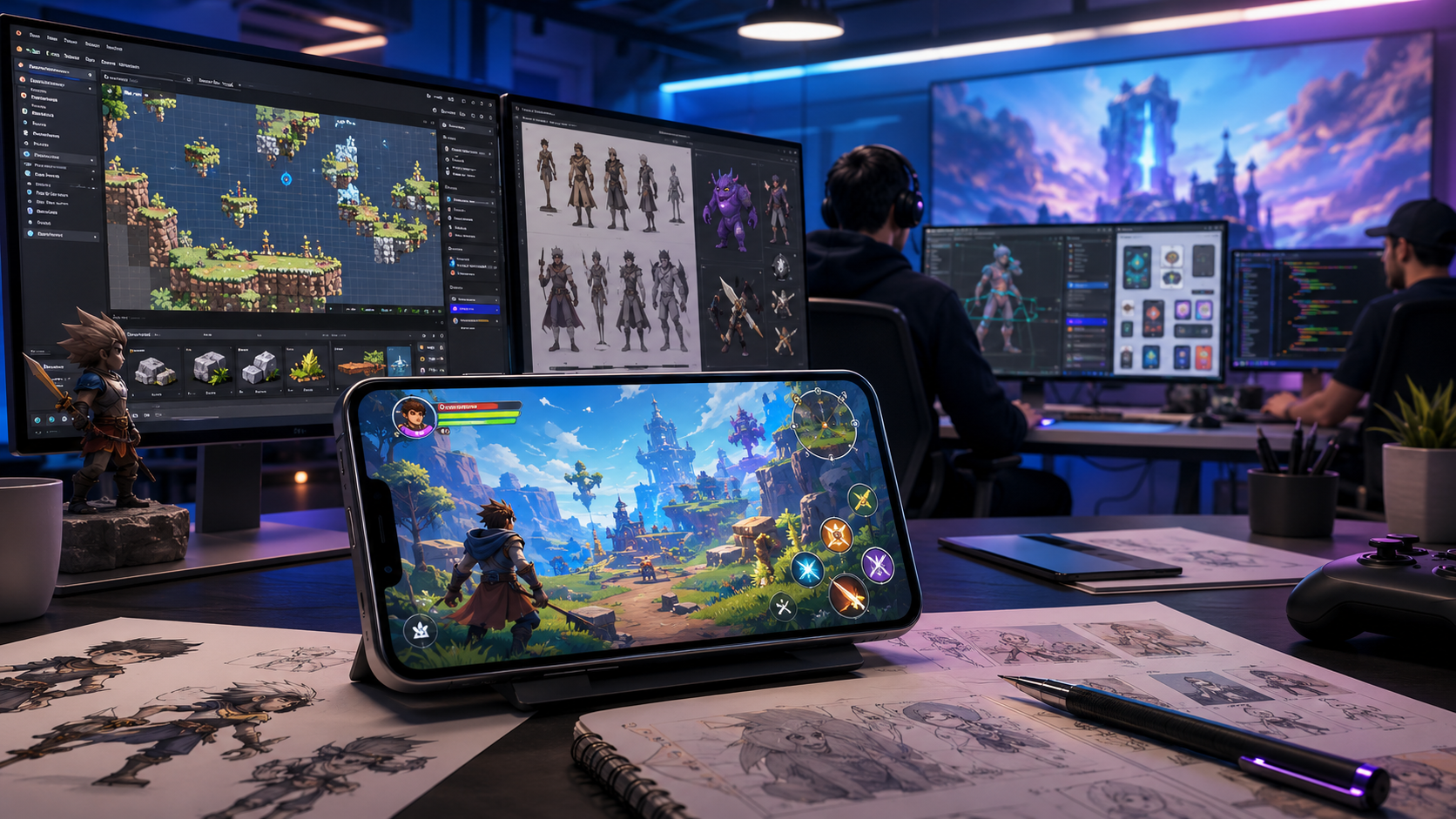

Mobile games have changed quite a bit. A few years ago, a small studio could build a simple puzzle game, publish it, run a few ads, and see what happened. That route still exists, but the bar is higher in 2026.
Players expect fast loading, clean controls, polished visuals, frequent updates, fair monetization, and a game that runs well on everything from a newer iPhone to a mid-range Android device. Miss one of those pieces and people notice. Usually pretty quickly.
That is why businesses looking for mobile game development services are rarely searching for programmers alone. They need a team that can handle game design, art, code, testing, store preparation, analytics, updates, and all the little things nobody thinks about during the first exciting meeting.
And there are a lot of little things.
A mobile game may look simple on a phone screen, but behind that screen sits a mix of design decisions, technical limits, platform rules, art production, monetization logic, device testing, and player behavior. Get those parts working together and the game feels effortless. Get them wrong and even a beautiful concept can feel frustrating.
Why mobile game development feels different in 2026
The biggest change is not one particular technology. It is the level of competition.
Players already have thousands of games available to them. They do not owe a new title ten minutes of patience. If the first session is confusing, slow, overloaded with pop-ups, or simply boring, uninstalling takes a couple of taps.
So development teams are paying much more attention to the first few minutes of play.
Does the game explain itself without a wall of text? Does the first interaction feel satisfying? Can someone understand the main goal quickly? Does an ad appear before the player even cares about the game?
These sound like small questions. They are not.
Mobile development has also become more connected to live operation. Publishing version 1.0 is often the beginning of the work rather than the finish line. Studios watch technical errors, player progression, retention patterns, purchases, level difficulty, and feedback after launch.
Then they adjust.
What mobile game development services usually include
The phrase mobile game development services covers far more than writing code.
A full development team may take a project from a rough idea to a game available through major app stores. Other studios handle only part of the job, such as programming, game art, porting, multiplayer systems, or ongoing support.
A typical project can involve:
- game concept and gameplay design;
- 2D or 3D art production;
- UI and UX design for touch screens;
- iOS and Android programming;
- animation, visual effects, and sound integration;
- backend and multiplayer features;
- in-app purchases and ad integration;
- quality assurance across different devices;
- analytics and crash reporting;
- store preparation, release support, and post-launch updates.
Not every project needs every item on that list. A small offline puzzle game is very different from a multiplayer strategy title with accounts, cloud saves, seasonal content, and daily events.
That difference is why asking, “How much does a mobile game cost?” is a little like asking how much a house costs. A studio apartment and a four-bedroom home are both places to live, but the numbers do not have much else in common.
The idea comes first, not the graphics
It is tempting to begin with character sketches, cool environments, or a dramatic trailer idea. Those things are fun. But the basic gameplay loop matters more.
What does the player actually do?
Maybe they match objects, build a city, race, solve puzzles, manage a restaurant, collect characters, defend a base, or compete with friends. Whatever the answer is, that action needs to feel good before hundreds of art assets are built around it.
This is where prototyping earns its keep.
An early prototype can be ugly. Gray boxes are fine. Placeholder buttons are fine. Temporary sounds are fine. The goal is to learn whether the core idea has legs.
A development team may test several versions of the same mechanic before settling on one. That can feel like extra work at first, but it is much cheaper than discovering six months later that the central gameplay simply is not fun.
iOS, Android, or both?
For most U.S.-focused commercial projects, the conversation eventually reaches the same question: should the game launch on iOS, Android, or both?
There is no single right answer.
Launching on both platforms gives a title access to a broader audience, but it also creates more testing work. Android is especially diverse because games run across a huge range of phones and tablets with different processors, screen sizes, memory levels, and graphics capabilities.
| Area | iOS | Android |
|---|---|---|
| Hardware range | More controlled device family | Very broad device range |
| Store | Apple App Store | Google Play and other Android stores |
| Testing | Still important across supported devices | Often requires broader hardware testing |
| Payments | Must follow Apple platform rules | Must follow Google Play rules where applicable |
| Privacy | Apple privacy and tracking requirements apply | Android and Google Play data policies apply |
| Good fit | Premium mobile audience and Apple ecosystem | Large and diverse device audience |
Cross-platform engines make supporting both systems more practical. Still, “build once and forget about platform differences” is mostly a nice sales sentence.
Real projects need platform-specific testing, permission handling, store setup, performance checks, and sometimes interface changes.
Unity and Unreal are still major names
Engine choice gets plenty of attention, sometimes more than it deserves.
Unity remains a common option for mobile titles, particularly projects that need broad platform support and a mature ecosystem of development tools. Unity 6 continues to be the current engine generation, with Unity 6.3 LTS available for teams that prefer a long-term-support release.
Unreal Engine is another major option. Its current mobile documentation supports development workflows for Android and Apple platforms, while Unreal’s rendering tools make it attractive for visually ambitious 3D projects.
But there is a catch.
The “better” engine is the one that fits the game, the team’s experience, and the production plan. A casual 2D word game does not need to prove anything by running on the heaviest tool available. Likewise, a graphically rich 3D action title may need a very different technical foundation.
Some studios also work with custom engines or lighter frameworks. That can make sense when the project has unusual technical needs.
Engine choice matters. It just should not become a religious debate.
Performance is part of the game design
A mobile game can look fantastic on a development workstation and still struggle on an actual phone.
Phones have limited battery capacity. They can heat up. Memory matters. Graphics hardware varies. Background processes consume resources. Players may also be on weak mobile networks rather than perfect office Wi-Fi.
That means performance planning should start early.
A team may need to control texture sizes, polygon counts, visual effects, memory consumption, network traffic, loading behavior, and the number of active objects in a scene.
And there is another practical issue: battery drain.
If a casual game turns somebody’s phone into a pocket heater after 15 minutes, gorgeous shadows are not going to save the experience.
Good mobile game development services account for those limits during production rather than treating performance as an emergency task before launch.
Google Play requirements are moving again
Platform requirements do not sit still, and 2026 is a good example.
Starting August 31, 2026, new mobile apps and app updates submitted to Google Play must target Android 16, API level 36, or higher under Google’s current target API requirements.
For studios, this is not trivia. Development schedules need room for operating-system updates, SDK changes, store requirements, and third-party plugin compatibility.
An old project that worked perfectly several years ago may need technical work before a new store update can be released.
This is one reason ongoing maintenance belongs in the budget conversation. A mobile game is tied to platforms that keep changing beneath it.
Privacy is now part of development, not paperwork
Privacy decisions used to feel like something the legal department handled near launch. That is no longer a smart approach.
Apple’s App Tracking Transparency framework, for example, requires permission when an app tracks users across apps and websites owned by other companies in situations covered by Apple’s tracking rules.
Google Play also maintains policies around user data, permissions, disclosure, and sensitive information.
So analytics and advertising tools cannot simply be dropped into a project at the last minute.
A development team should know what data the game collects, why it is collected, which third-party SDKs receive it, and what permissions are actually necessary.
The cleanest permission request is often the one you never needed to request in the first place.
Monetization needs to fit the game
Here is where things can go sideways quickly.
A game may technically support ads, in-app purchases, subscriptions, cosmetic items, premium unlocks, or some combination of them. That does not mean every monetization option belongs in the same project.
The business model should fit the player experience.
For example, interrupting a calm puzzle session with an ad every thirty seconds may create revenue impressions, but it can also make the game exhausting. On the other hand, a completely free game with expensive servers and no revenue plan is not exactly a business model either.
Common mobile approaches include:
- paid downloads with no additional purchases;
- free games supported by advertising;
- free-to-play games with in-app purchases;
- cosmetic items that change appearance rather than gameplay;
- subscriptions for recurring content or benefits;
- hybrid models combining ads with optional purchases;
- premium upgrades that remove ads or open extra content.
The key is timing and value. Players are far more open to paying when they understand what they are receiving.
Throwing a purchase screen at someone before they understand the game is like handing a restaurant bill to a customer before they have seen the menu.
LiveOps has become a bigger part of the job
Many successful mobile games keep changing after release.
New levels arrive. Limited events run for a weekend. Characters are added. Rewards change. Seasonal themes appear. Bugs are fixed. Difficulty curves get adjusted.
This ongoing work is often described as LiveOps, short for live operations.
Unity itself now provides mobile development resources around LiveOps and live services, which says a lot about how normal this production model has become.
But LiveOps is not simply “keep adding stuff.”
Good live operation starts with understanding how people are actually playing. Maybe players abandon level 12 because its difficulty jumps too sharply. Maybe a reward that seemed generous during testing barely gets noticed. Maybe a new event causes a technical problem on one group of Android devices.
Data helps teams notice those patterns. Human judgment still decides what to do about them.
How a mobile game project usually moves from idea to launch
Most professional projects move through several production stages, even if teams give those stages different names.
| Stage | Main goal | Typical output |
|---|---|---|
| Discovery | Define the concept and audience | Game brief and feature outline |
| Prototype | Test the core mechanic | Basic playable version |
| Pre-production | Plan art, technology, UX, and scope | Production roadmap |
| Production | Build the actual game | Playable content and systems |
| QA | Find bugs and device issues | Test reports and fixes |
| Soft launch or controlled testing | Observe real player behavior | Gameplay and business insights |
| Release | Publish the game | Store-ready public version |
| Post-launch | Maintain and expand the title | Updates, events, fixes, new content |
Smaller games can move through these stages quickly. Large titles may spend months in production before reaching a stable release candidate.
The important point is that the stages exist for a reason.
Skipping a prototype because “the idea is obviously good” can become expensive. Skipping QA because “it works on our phones” is even worse.
Testing on real devices still matters
Emulators and development tools are incredibly useful, but they do not remove the need for real hardware.
A game may run smoothly on a flagship phone and stutter on a device with less memory. A button can fit nicely on one screen and overlap another interface element on a different aspect ratio.
Then there are interruptions.
What happens when a phone call arrives? What if the player switches apps and returns later? What if the network disappears during a purchase? What if Bluetooth headphones disconnect?
Players do these things every day. Games need to survive ordinary phone behavior.
What should be ready before you contact a studio?
You do not need a 60-page design document before speaking with a development company. In fact, an experienced studio may help shape the concept.
But some preparation makes the first conversation much more productive.
- Write the core game idea in two or three sentences.
- Describe the people you expect to play it.
- Name a few existing games that feel similar in mechanics or style.
- Decide whether iOS, Android, or both are priorities.
- List features that absolutely must be included.
- Separate those features from the ideas that would simply be nice to have.
- Think about multiplayer, accounts, purchases, ads, and online features early.
- Have a realistic budget range in mind.
- Know whether the project needs a one-time launch or continuing support.
That “must have” versus “nice to have” distinction is especially useful.
Feature lists have a funny habit of growing during development. One extra mode becomes social features. Social features become profiles. Profiles become friend lists. Then somebody asks whether players can send gifts.
And suddenly the small casual game has a backend worthy of a much bigger product.
What determines the cost of mobile game development?
The biggest factor is scope.
A basic 2D game with a handful of screens and offline gameplay requires less work than a 3D multiplayer game with dozens of characters, custom animation, user accounts, cloud saves, matchmaking, and continuous content updates.
Art style matters too.
Simple does not always mean cheap, by the way. Clean minimalist art can require very careful design. But producing hundreds of detailed characters, environments, animations, effects, and UI elements naturally adds production time.
Backend work can also change the budget significantly. Local single-player logic lives largely on the player’s device. Multiplayer, accounts, leaderboards, persistent inventories, social systems, and server-authoritative gameplay add another technical layer.
Then comes QA.
The more devices, systems, game modes, languages, payment flows, and online features a project supports, the more situations need testing.
This is why reputable studios normally need more than a sentence describing the game before giving a meaningful quote.
Should you build an MVP first?
Often, yes.
An MVP — minimum viable product — is a smaller version that proves the essential idea without building every dream feature on day one.
For games, though, “minimum viable” needs a little care. A business app can sometimes survive looking rough during early testing. A game exists largely because people enjoy interacting with it.
So the core experience still needs enough polish to produce useful feedback.
The goal is not to publish something bad cheaply. It is to learn what deserves more investment.
Maybe players love the mechanic but ignore the progression system. Great. Now the team knows where to work.
Maybe nobody understands the tutorial. Also useful.
Finding these things early is much nicer than finding them after a large marketing campaign starts.
2D or 3D? There is no automatic winner
3D often gets treated as the “premium” option, but that is too simplistic.
Some of the most natural mobile experiences are built around clean 2D graphics. They load quickly, read well on small screens, and can support a strong visual identity without asking much from the hardware.
3D makes sense when depth, camera movement, spatial gameplay, character movement, or visual spectacle adds something important.
What matters is the relationship between art and gameplay.
A gorgeous 3D environment does not fix an uninteresting mechanic. At the same time, strong art can make familiar gameplay feel fresh.
Players experience both together, so development teams should think about them together.
AI is entering the workflow, but control still matters
AI-assisted tools are increasingly appearing in parts of game production, including concept work, coding assistance, testing workflows, localization support, asset exploration, and internal productivity.
That does not mean developers can type “make me a successful game” and head out for coffee.
Commercial development needs consistency.
A character cannot suddenly have a different costume in every scene. A generated code suggestion still needs review. Art needs to match the game’s direction. Third-party material needs proper rights and licensing checks.
For studios, AI is becoming another tool in the box rather than a replacement for design judgment.
And that’s probably the less exciting but more accurate version of the story.
How to judge mobile game development services
A shiny portfolio is useful. It is not enough.
Look at the kind of games a studio has actually built. A team experienced with casual 2D games may be fantastic, but that does not automatically make it the right crew for a network-heavy 3D action project.
Ask how the studio handles testing. Ask what happens after launch. Ask who owns the source code and project files. Ask how changes are approved and how progress is shown.
Communication matters more than many clients expect.
Game development includes dozens of small decisions. If nobody knows who can approve them, production slows down. If every stakeholder gives conflicting feedback, it slows down even more.
A clear process may not look glamorous in a pitch deck, but halfway through a project it feels pretty glamorous.
FAQ About Mobile Game Development Services
What are mobile game development services?
They cover the professional work needed to design, build, test, publish, and maintain games for smartphones and tablets. Services may include coding, art, UX, backend systems, QA, monetization, analytics, and post-launch support.
How long does it take to develop a mobile game?
It depends heavily on scope. A small prototype may come together relatively quickly, while a polished commercial game with extensive art, multiplayer systems, and many levels can require a much longer production cycle.
Is Unity good for mobile games in 2026?
Yes. Unity remains actively supported for mobile development, and Unity 6 is its current engine generation. The right engine still depends on the project and the team’s experience.
Can one mobile game run on both iPhone and Android?
Yes. Cross-platform engines can support both, but developers still need to handle platform-specific testing, store rules, SDKs, permissions, screen differences, and device performance.
Do mobile games need ongoing maintenance?
Usually, yes. Operating systems, store policies, SDKs, devices, and third-party services change. Live games may also need bug fixes, events, balance changes, security updates, and new content.
How much do mobile game development services cost?
There is no reliable flat price because the workload depends on art, gameplay, backend features, platforms, multiplayer requirements, testing, content volume, and support after launch.
Should a startup build the full game immediately?
Usually not. A prototype or smaller first version can test the main idea before the company commits a larger budget. The core gameplay still needs enough polish to generate meaningful feedback.
Conclusion: Build the Game Around the Player
Mobile game development in 2026 is not just about getting something to run on a phone. That part is only the foundation.
The real work is creating an experience people understand quickly, enjoy enough to return to, and can play without fighting performance problems, confusing menus, or aggressive monetization.
Technology helps. Unity, Unreal Engine, modern backend platforms, analytics systems, cloud services, and better development hardware give studios more options than ever. But more tools do not automatically create better games.
Good decisions do.
Strong mobile game development services begin by asking simple questions: What is fun here? Who is this for? What really needs to be in version one? What can wait? Which devices matter? How will the game earn money without annoying the people playing it?
Those questions sound almost too basic. Yet they often separate manageable projects from projects that keep growing until nobody remembers the original idea.
There is also no need to chase every trend. A game does not need multiplayer because multiplayer is popular. It does not need 3D because 3D looks expensive. It does not need AI features because everybody is talking about AI.
It needs a reason to be played.
Start there. Build a good core loop. Test it on real people and real phones. Keep the scope under control. Plan for app-store rules and platform changes early rather than treating them as launch-week surprises.
And if the game works, then there is plenty of room to grow — more levels, events, new characters, social systems, seasonal content, or whatever genuinely makes the experience better.
That is the nice thing about mobile games. They may begin as a tiny icon on someone’s home screen, but behind that icon can sit years of ideas, updates, player stories, and a business that keeps evolving.
The trick is making the first tap worth a second one.
Leave a Reply