

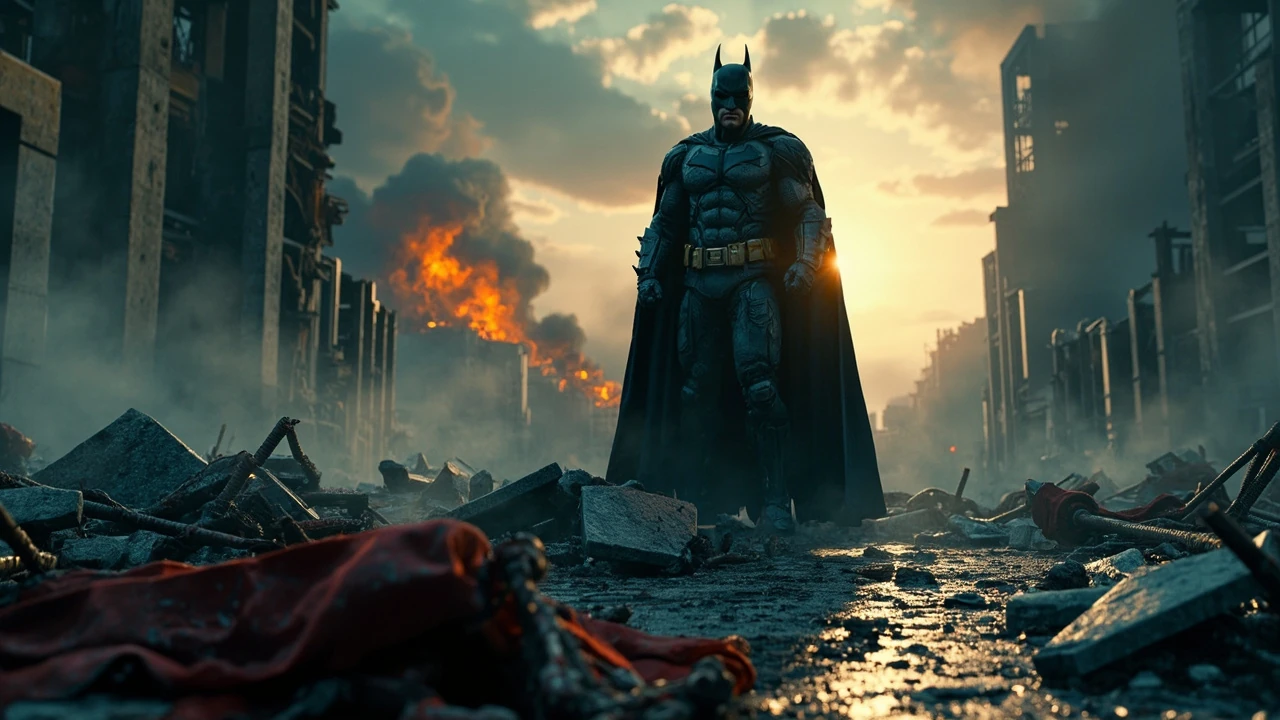

Injustice 3: what a third entry in the DC fighting franchise would actually need to deliver
A new entry in the Injustice 3 conversation keeps surfacing because the DC fighting game series left an unusual shape in the market. Two mainline games, a mobile companion that ran for years, and a roster of heroes and villains with abilities tuned around a superhero rule set rather than a traditional martial arts template. The question most readers actually want answered is not “is the game real.” It is what kind of game a third entry would have to be to justify its place in a genre that has moved on significantly since the last mainline release, what constraints the franchise carries from its narrative and design history, and how a development team would approach the project if it were greenlit. This page treats injustice 3 as a game development subject, not as a rumor tracker, and explains the franchise, the design choices that defined it, and the production problems a sequel would have to solve.
For background on the wider franchise and its place in fighting game history, the Injustice series page on Wikipedia gives a clean overview of the two mainline games, the mobile title, and the studio lineage. For a deeper look at the moral and narrative framing that the series borrows from philosophical concepts of fairness and redress, injustice and rectification provides the conceptual scaffold that the story mode adapts. Both links sit naturally in the body of this article and are the only two external sources used.
Why the Injustice franchise exists as a separate product line
The Injustice series is, mechanically, a 2.5D fighting game with a three-button attack layout, character gear, and stage interactions built around a small number of interactive objects. What makes it stand apart from its peers is the licensed DC Comics roster and a story mode structured around an alternate universe in which Superman becomes a tyrant after the Joker tricks him into killing Lois Lane and destroying Metropolis. That premise is not decorative. It dictates the tone, the stage design, the camera language, and the rules the cast has to play inside.
The original Injustice: Gods Among Us (2013) was developed by NetherRealm Studios and published by Warner Bros. Interactive Entertainment. It positioned the studio as a credible alternative to Capcom’s Street Fighter and Bandai Namco’s Tekken by leaning on cinematic presentation and a roster of characters whose powers range from street-level martial arts to literal planet-crushing. Injustice 2 (2017) extended the formula with a gear system that layered stat and cosmetic changes on top of the base moveset, and with Multiverse mode, a live-style content rotation that became a long-tail engagement mechanic on consoles.
Those two releases are the reason injustice 3 is a meaningful subject at all. The franchise has a defined combat language, a defined narrative premise, and a defined roster philosophy. Any sequel has to respect all three or it stops being a recognizable member of the series.
The reader this article is for
There are two distinct audiences for an article on this topic and they want different things. The first is a player who wants to know whether a new game is in the works, when it might appear, which characters could return, and how the story might continue. The second is a game developer, technical artist, or designer who wants to understand the production challenges a sequel would face, the design constraints that come with the DC license, the way the gear system influences balance, and the live operations questions that a fighting game with a single-player progression mode creates. This page is written for the second audience. Player-facing news and rumor coverage is treated as a separate article type and is not folded in here. Where a player question overlaps with a development question, the answer is written from the development side.
What “Injustice 3” actually has to decide before a single move is built
Before any character is designed, any stage is mocked up, or any piece of code is written, a fighting game project of this scale has to lock a small set of high-level decisions. These are the decisions that ripple through every other part of production, and they are the ones a hypothetical injustice 3 project would have to make early. They are the same decisions any licensed fighting game has to make, but the franchise’s history makes some of them more constrained than they would be for an original IP.
Engine, platform list, and rendering target
The previous two mainline games ran on a modified version of the Unreal Engine family of tools. Any third entry would face the same question most mid-to-large studios face today: continue on a known engine with a known toolchain, or migrate to a newer engine branch to take advantage of better lighting, improved animation graphs, and current generation hardware features. That decision is not cosmetic. It affects content throughput, hiring, outsourcing, and the schedule for the first playable build.
Platform list matters as much as engine. The original release targeted PlayStation 3, Xbox 360, Wii U, and PC. The sequel targeted PlayStation 4, Xbox One, and PC. A third entry would, at minimum, target current generation consoles and PC, and would face an immediate question about whether to commit to a portable or handheld SKU. That commitment changes the resolution pipeline, the texture budget, the input model, and the online netcode assumptions before any combat work begins.
Netcode and online architecture
Fighting games live or die on their online play. The two Injustice mainline games shipped with delay-based netcode, which was the industry default at the time of their release. A new entry would face a market where rollback netcode has become a baseline expectation for competitive play. Choosing rollback over delay is not a simple toggle. It changes how moves are simulated on each client, how the input pipeline is structured, what state has to be deterministic, and how the team tests online play before launch.
Roster scope and the “real” versus “alt” character question
Roster size is the most visible production decision in any fighting game and the one most readers notice first. The original Injustice: Gods Among Us shipped with 24 playable characters on the main disc plus additional DLC characters. Injustice 2 shipped with 28 on disc plus DLC. A third entry would have to balance the desire for a larger roster against the cost of building each character and the budget for cinematic story content. A more interesting decision is the ratio of “real” characters to alternate versions. The franchise has already used the device of Superman from a parallel timeline, a red-sun weakened Superman, and various Joker variants. That approach lets a team expand the roster without designing a new moveset from scratch, but it also trains the audience to read every character reveal as a question about which version of the hero is on screen.
Narrative continuity and the universe reset
The story mode is the single most expensive piece of content in a game of this type, and it is the part that the license most directly constrains. The series has already burned through the “Superman becomes a tyrant” arc and the “Batman resists and the regime falls” arc. A third entry would either need to continue that thread into a less obvious direction, reset the universe, or treat story mode as a per-character cinematic mode rather than a single linear campaign. Each of those choices has production consequences. A linear campaign with full cinematics is the most expensive route. A reset trades continuity for design freedom. A per-character mode lets the team reuse existing assets but dilutes the narrative weight the series has built up.
Live service or packaged release
Injustice 2 introduced Multiverse mode, which is best described as a rotating single-player content layer with its own challenges, modifiers, and rewards. A third entry would have to decide whether to expand that into a longer live service commitment with seasonal content, or to return to a more traditional packaged release with Multiverse as a finite mode. The live service route creates ongoing server, design, and community management cost after launch. The packaged route reduces that cost but removes the long tail of engagement that a fighting game roster thrives on.
How the Injustice combat system actually works under the hood
It is worth restating the combat system in production terms because a lot of the design choices an injustice 3 project would face come down to which parts of the existing system the team keeps and which it rewrites. The series is built on a 2.5D plane with three-dimensional character models, a four-button layout (light, medium, heavy, character power) plus a dedicated trait button, and an environment interaction system that turns certain stage elements into usable attacks or hazards. That structure is the spine of the game and is unlikely to change dramatically in a sequel, because the audience that buys the game is the audience that already learned the system.
The role of the trait system
Each character has a trait that is unique to them, activated by pressing the trait button, and tuned around their specific powers. Batman’s trait deploys a gadget, Green Lantern’s trait builds a construct, Superman’s trait triggers a flight-based attack. The trait system is what gives the cast its superhero flavor and is also the part of the system that drives most of the balance work. A sequel would need to preserve the principle (one signature move per character) while making sure the trait is not so strong that it dictates the neutral game.
The clash system and risk-reward design
The original game introduced a clash mechanic in which both players can simultaneously spend a portion of their super meter to enter a wagered sequence. The higher spender wins, and the loser takes the resulting damage. The mechanic is a soft comeback tool and a way to break out of pressure. A sequel would need to keep or replace it carefully, because it is one of the few mechanics that gives the game a non-neutral decision in a wide range of situations.
The super move and environmental interaction
Super moves are short cinematic sequences that resolve with a guaranteed hit and high damage. They are gated by a meter that fills through combat and, in the original, by stage interactions. Stage interactions are triggered when a player uses a heavy attack near certain objects, transitions the action to a short mini-stage, and gives the attacker a small advantage. A sequel has to decide whether to keep both, keep one, or replace them with a new layer of cinematic interaction. The decision is partly about visual identity and partly about balance, because environmental interactions add variance to neutral play that competitive players either love or hate.
Roster design as a production problem, not a marketing problem
Roster reveal trailers drive preorders, but each character is a real production object. A character needs a model, a skeleton, a moveset, a set of special moves, a trait, a super, a cinematic intro and win animation, a set of voice lines, a stage or two, and a slot in the story mode. For a hero with a complex power set, that work can take the better part of a year for a single character. For a roster in the high twenties, that is a multi-year content plan. The table below summarizes the rough categories of work that go into a single fighter and the parts of the team that own them.
| Production area | What it produces | Owning discipline | Dependency on other systems |
|---|---|---|---|
| Character base mesh and skeleton | Hero model, rigging, and skinning | Character art | Engine, animation pipeline |
| Idle, walk, and run animations | Locomotion cycle and small body reactions | Animation | Skeleton, motion capture library |
| Normal and special moves | Combat moveset and hitbox data | Combat design, animation, VFX | Frame data tools, balance sheet |
| Trait and super | Signature mechanics and cinematic | Combat design, animation, audio, VFX | Super meter, camera system |
| Voice and cinematics | Intro, win, and story dialogue | Narrative, audio, capture | Script, casting, localization |
| AI and tutorial coverage | Opponent behavior and learning steps | AI engineering, combat design | Behavior tree, training mode |
| Balance pass | Frame data and damage tuning | Balance lead, design | Telemetry, internal playtests |
For a injustice 3 project, that table is the working surface the team has to plan against. The headline roster number is a function of how much of that work the schedule can absorb, not of how many silhouettes fit on the select screen.
Stage design and the visual identity of the game
The stages in the series are designed to read as the comic book world first and as a fighting game arena second. Gotham, Metropolis, Themyscira, the Batcave, Atlantis, and the Fortress of Solitude are all recognizable locations with their own visual palette, and each stage is built around one or two interactive elements that can be triggered during a round. A sequel has to keep the sense of place while adding enough new environments to make the next entry feel like its own game rather than a re-skin of the previous one.
Stage design also matters for performance. Each stage has its own lighting, background animation, destruction logic, and set dressing. A team that wants to add more interactive stage elements has to budget the polygon count, the overdraw, and the streaming cost of the additional geometry. The following list summarizes the constraints a level artist works against on a current generation build of this style of game.
- Draw call budget per frame for the foreground action and the stage background combined
- Texture streaming budget for the unique set dressing and the stage lighting probes
- Physics and destruction budget for the interactive objects, with a hard cap on simultaneous active objects
- Audio budget for stage-specific ambience and the localized hit reactions on stage geometry
- Narrative ownership of the location, so the stage reads as the right part of the DC universe
A new entry would have to decide whether to push the interactive layer further (more destructible objects, more stage transitions) or to back off the interactivity in favor of higher visual fidelity. Both are defensible choices and they produce very different games.
Story mode as a production line
The story mode in the series is, in production terms, a long-form cinematic project that uses the combat engine as a substitute for traditional action set pieces. Each chapter is a self-contained mission with scripted sequences, multiple combatants, and at least one boss fight against a character whose moveset the player does not control. A new entry would have to allocate budget across several distinct kinds of story content.
- Script and storyboard for each chapter, with branching awareness for the player’s roster
- Performance capture and dialogue for the named characters in the chapter
- Level art for the chapter’s stage and set dressing
- AI and encounter scripting for the chapter’s combat sections
- Localization, audio mixing, and cinematic editing for the final cut
The reason the story mode has been so important for the franchise is that it gives the game a single-player identity that a pure versus fighting game does not have. It is also the part of the game that the DC license most directly funds, because the cinematic work is what the parent company at Warner Bros. Discovery uses to coordinate the game’s release with other DC properties. A injustice 3 project that drops or shortens the story mode is making a different game with a different relationship to the license.
The gear system and the live service question
Injustice 2 introduced a gear system that gave each character multiple equipment slots, each of which altered a small number of stats and a larger number of visual properties. The system turned the roster into a long-tail collection game and gave the player a reason to keep playing after the story was done. It was also one of the most heavily discussed design choices in the game, because it created a balance problem: a player with a fully optimized gear set could be measurably stronger than a player with a starter set.
A sequel would have to decide how to treat this. There are essentially three production positions a project can take, and the table below summarizes what each one costs in design, engineering, and live operations effort.
| Position | Player experience | Balance cost | Live operations cost |
|---|---|---|---|
| Keep gear, expand it | Long-tail collection and customization, competitive split between gear tiers | High, gear stats must be balanced per character per slot | High, ongoing content drops and tuning |
| Keep gear, cosmetic only | Long-tail collection without the balance risk | Low, no stat changes from gear | Medium, ongoing cosmetic content |
| Remove gear entirely | Single roster, no collection loop, balanced from day one | Low, balance is per character only | Low, no gear economy to maintain |
Each of these positions is a defensible design choice. The decision is not about which one is “right” in the abstract. It is about which one fits the live service commitment the publisher is willing to fund and the audience the team is trying to reach.
Netcode, rollback, and the competitive scene
When the first Injustice shipped, delay-based netcode was the default for console fighting games. Since then, the community expectation has shifted toward rollback netcode as the baseline for a competitive release. Rollback is harder to implement, harder to test, and harder to support after launch, but it produces a much better experience over a connection that drops frames. A new injustice 3 project would face a market in which releasing without rollback would be a competitive disadvantage, regardless of how the previous games handled online play.
For a development team, the rollback decision is not a single engine toggle. It is a set of decisions that touch the input pipeline, the simulation model, the state rollback logic, the visual interpolation system, and the test infrastructure that the team uses to find desyncs. The list below summarizes the systems a team has to think about when it commits to rollback.
- Input determinism across clients, so the same inputs produce the same simulation
- State save and restore at the frame level, with a budget per rollback
- Visual interpolation for positions and animations that are corrected retroactively
- Network jitter and latency handling, with a target input delay the team commits to
- Desync detection, with a clear recovery path when state diverges
- Matchmaking that respects the latency budget the simulation can absorb
A fighting game project that does not commit to these systems in its design phase will pay for the choice later in player trust and post-launch support cost.
How a fighting game’s balance is actually produced
Fighting game balance is a production line in its own right. The combat designers produce a moveset for each character, the balance lead maintains a shared frame data and damage sheet, the AI team uses the moveset to produce opponent behavior in story and arcade modes, the training mode team exposes the same data to the player, and the QA team runs playtests against the shared sheet. The output of that work is a public frame data sheet, a tier list discussion, and a metagame that emerges from the actual play of the top players.
A injustice 3 project would have to staff that line, set the cadence of balance patches the team is willing to support, and decide how transparent the data will be. The following list captures the practical work that goes into one balance cycle.
- Internal playtests with the roster at a fixed patch level
- Telemetry from online play, if the project has the budget to collect it
- Tier list and matchup analysis from the competitive community
- Patch notes with explicit frame data and damage changes
- Regression testing for the changes against the AI and the tutorial mode
Without that loop, the game ships balanced and decays in quality as the community finds the dominant strategies. With the loop, the game stays close to its design intent for the entire life of the title.
Production phasing for a project of this scale
A project of this size is usually planned in a series of phases, each of which has a deliverable the next phase depends on. The phases below are a typical structure for a mid-sized studio on a licensed fighting game. They are not a schedule, because the duration of each phase depends on team size, engine familiarity, and the license approval cycle, but they are the shape a project has to take to reach a shippable build.
- Pre-production: vertical slice with two to three characters, one stage, and a representative slice of story mode, used to lock the engine, the combat rules, and the visual target
- Production: roster and stage content build, story mode scripting, online play integration, tutorial and training mode, and the first round of balance work
- Pre-launch: certification for each platform, store integration, marketing build preparation, and the first round of post-launch content planning
- Post-launch: balance patches, DLC characters and stages, Multiverse or live service content, and competitive scene support
For an injustice 3 project, the pre-production phase is the part the industry would watch most closely. The vertical slice is what tells the publisher whether the project can hit its content target, its visual target, and its online play target at the same time.
What a sequel would change, and what it would keep
It is worth being explicit about which parts of the franchise a sequel would have to keep and which parts it could change. The list below is not a design recommendation. It is a summary of the constraints a real project would face when it has to honor the license, the audience, and the development cost at the same time.
- Keep: the four-button combat layout, the trait system, and the DC character roster framing, because the audience learned the system on those terms
- Keep or replace carefully: the clash system, the super move structure, and the stage interaction system, because each one has a fan base and a balance cost
- Replace if budget allows: the gear system can be replaced or restricted to cosmetic only, depending on the live service commitment the publisher funds
- Replace with caution: story mode structure, because a per-character mode is cheaper but dilutes the narrative weight the series has built
- Replace: netcode, which has to move to rollback as a baseline competitive expectation
These are not abstract choices. They are the levers the production team turns when the project has to fit a budget, a schedule, and a license agreement at the same time.
Comparison with peers in the fighting game space
It is useful to position the franchise against the other major licensed and original fighting games that share its release window and its audience expectations. The table below is a working comparison, not a ranking. It is built from publicly observable design choices, not from internal data or undisclosed roadmaps.
| Property | Combat basis | Roster size at launch | Netcode baseline | Story mode treatment |
|---|---|---|---|---|
| Injustice series | 4-button, trait-driven, environment interactive | 24 to 28 on disc, expanded with DLC | Delay-based at original launch | Linear cinematic campaign with full voice work |
| Street Fighter 6 | 6-button, modern control scheme option | 18 characters at launch, expanded with DLC | Rollback at launch | World Tour single-player mode with avatar progression |
| Tekken 8 | 4-button limb-based, heat system | 32 characters at launch | Rollback at launch | Continuation of the Mishima saga as a cinematic story |
| Mortal Kombat 1 | 4-button, kameo partner system | 24 main plus kameo roster at launch | Rollback at launch | New timeline, cinematic single-player campaign |
The comparison is a useful reference for a development team because it shows the audience expectation baseline. A new injustice 3 project would have to deliver at least as much online play quality as the entries in the rightmost two columns, even though the franchise’s previous games launched on a different baseline.
Frequently asked questions
Is Injustice 3 confirmed?
There is no official confirmation of a third mainline entry in the series as of the current date. The franchise’s two mainline games are real and the mobile companion has been updated over time, but a third console release has not been publicly announced by the studio or the publisher. Anything beyond that is community speculation, retailer listing noise, or wishlist reporting, and should be treated accordingly.
Who would develop Injustice 3?
The previous two mainline games were developed by NetherRealm Studios. If a third entry were to be developed, the most natural studio for the work is the same one, because the engine knowledge, the animation library, and the combat system expertise are all concentrated there. A different studio is theoretically possible but would have to rebuild most of that institutional knowledge from scratch.
What characters would likely return?
Batman, Superman, Wonder Woman, the Joker, Harley Quinn, Aquaman, the Flash, and Green Lantern are the most likely core roster members because they have been the spine of the franchise’s marketing and story mode in both previous games. Whether they would be joined by a wide range of less obvious characters depends on the budget for character work and the current state of the DC cinematic slate.
Would the story mode continue from Injustice 2?
That is a production decision, not a creative one. A continuation respects the narrative weight the series has built but constrains the design space. A reset gives the team more freedom but loses the player investment in the existing universe. The decision is usually made in early pre-production and is one of the first things the publisher signs off on.
Would the gear system return?
It could. The franchise has already built the design and the tooling for the gear system, so a third entry could keep it, restrict it to cosmetic only, or remove it entirely. The choice is driven by the live service commitment the publisher is willing to fund and by the balance philosophy the team wants to ship with.
Would Injustice 3 use rollback netcode?
For a current generation release, rollback is the expected baseline. A new entry in the series would face a competitive scene that already plays Street Fighter 6 and Tekken 8 on rollback, and shipping without it would be a noticeable step backward for the game’s online audience. The implementation is a real engineering cost, but it is one the genre has effectively made mandatory.
Could the game run on handheld or portable hardware?
A portable SKU is technically possible but is a separate production commitment. The performance budget for a current generation build is tight, and a handheld target has to be designed in from the start of the project rather than added as a port at the end. The decision affects resolution pipeline, texture budget, and the input model from day one.
What is the most important design decision for a sequel?
It is the live service commitment, because it determines the production cost of the game after launch. Everything else, from the roster size to the gear system to the story mode structure, is downstream of how long the publisher wants the game to be supported and how much ongoing content the team is funded to produce.
How long would development take?
A mainline entry in a franchise of this scope typically takes three to four years of production from greenlight to ship, plus the pre-production phase that defines the vertical slice. That estimate is a planning number, not a schedule, and it depends on team size, engine familiarity, and the license approval cycle that the publisher has to manage.
Where can I follow official updates?
Official updates on a game of this scope, if they are announced, would be published through the studio’s and the publisher’s own channels first. The franchise’s Wikipedia entry, the Injustice series page, is a useful aggregator for the confirmed history of the franchise. The wider conceptual framing that the story mode adapts, including the philosophical treatment of fairness and redress, is summarized in the injustice and rectification text, which is the second and last external source used in this article.
Leave a Reply