


Heliostat Destiny 2: how the Plaguelands exotic mission works
Heliostat Destiny 2 is the new exotic mission that shipped with the Ash and Iron update, and it sends a three-player fireteam back into the Plaguelands, where the Warlock Maya Sundaresh is preparing to launch a Warsat. The reward for a full clear is Wolfsbane, a sword-class exotic whose two-handed axe animations and Solar relic flourishes make it feel closer to an Iron Lord weapon than a standard heavy. The activity lives in the Pinnacle Ops section of The Portal, sits beside other rotating endgame content, and does not appear on the destination director the way older campaign missions once did. That entry point is the first practical step, because many players load into the Plaguelands expecting a traditional story node and waste a session looking for a marker that no longer exists.
This walkthrough is written for a developer-minded reader who wants more than a checklist. It covers how the Psion ally summons gate progression, the practical steps for unlocking Wolfsbane’s intrinsic traits and catalysts, and the design decisions that shaped the activity, from the reusable rally-circle mechanic to the choice to recycle a familiar location. Those design choices explain why Heliostat feels different from a standard Strike and how Bungie is testing exotic-mission templates for future seasons of the live game.
Starting the Heliostat mission from The Portal
Heliostat is hosted inside the Pinnacle Ops node of The Portal rather than on the Plaguelands destination itself. The Portal is the central endgame matchmaking screen that replaced the old seasonal challenge banner for many activities, and Pinnacle Ops is the submenu that lists high-difficulty or mission-style content. Players open The Portal, scroll or filter to Pinnacle Ops, then locate Heliostat in the activity list. New activities are not always surfaced at the top of the list, so the entry may sit a few rows down under older Pinnacle Ops content. Selecting Heliostat opens a launch prompt that asks for a fireteam size and displays the recommended Power delta for the run.
Because Heliostat is a fireteam activity, the matchmaking rules deserve a quick summary before the walkthrough. Solo players can launch a private instance from the Portal and invite others, but the encounter balance assumes a coordinated team. The mission uses a checkpoint system similar to other Pinnacle Ops content: a wipe sends the fireteam to the last rally circle rather than the very beginning, which keeps the run length manageable even when the team struggles. The mission does not have a separate launch fee or currency, but it may require a specific Power floor that is enforced by the Portal. A player who tries to launch below the recommended Power will see a warning rather than a hard lock, although under-leveled runs tend to fail the orange-radiation sections because the shielding windows become too short to survive at the deeper gauntlets.
Opening route: clearing the Plaguelands perimeter
After the loading screen, the fireteam spawns on a scaffolding approach to the Plaguelands facility. A small mixed group of Cabal and Vex patrols the entry plaza, and the encounter reads more like a tutorial than a real fight. Clearing those enemies unlocks the path to the first rally point and teaches the basic combat loop the rest of the mission relies on. The mixed Cabal and Vex composition is a callback to the original Plaguelands content, which keeps the design coherent even though the surrounding map has been visually refreshed for the Ash and Iron era.
From the entry plaza, the path forward is blocked by a sealed bulkhead and a corridor filled with orange radiation. The radiation is the mission’s main gating tool, and every later rally point uses the same mechanic in different layouts. The key is to summon a Shielding Psion before entering the orange haze, then keep moving until the next safe zone. Players who stop to fight inside the radiation without a shield are eliminated quickly, because the damage over time scales with how deep the team has pushed into the corridor and with the Power delta relative to the recommended level.
Shielding, Quicksilver, and Reconstruction: the three Psion types
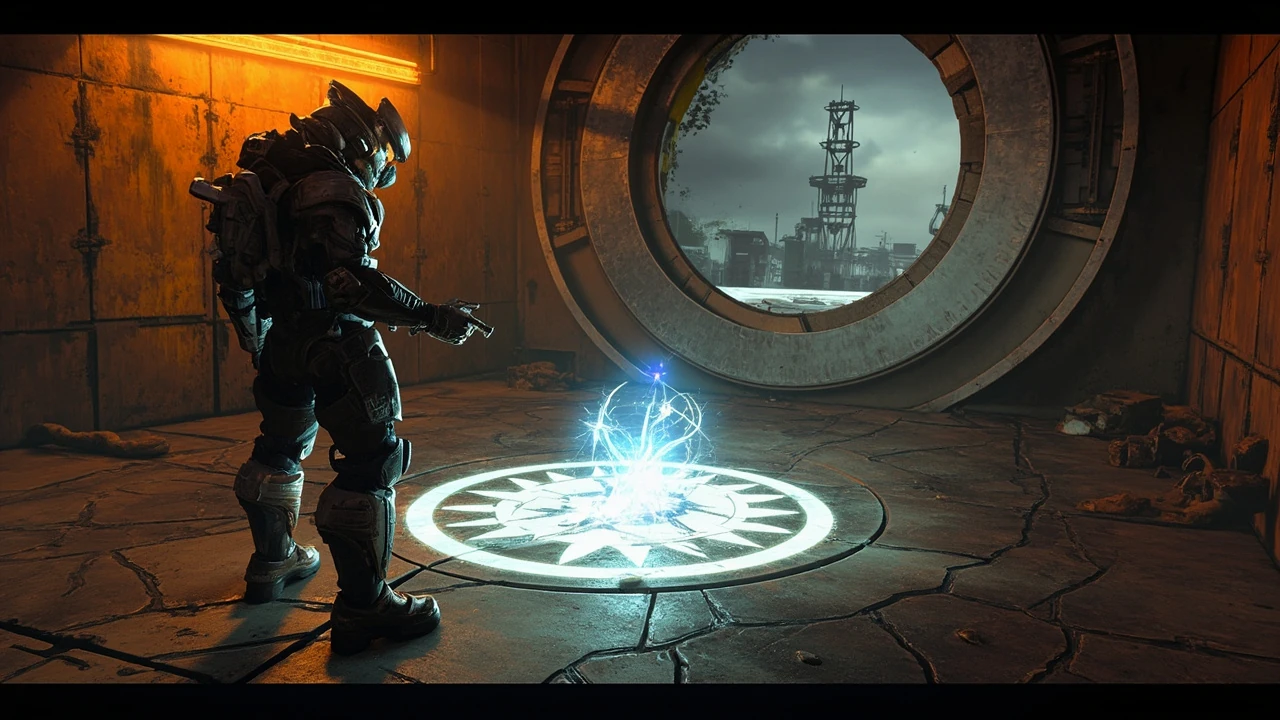
Heliostat uses three distinct Psion ally types, and each is summoned by standing in a white circle marker on the ground that resembles a rally flag. The visual language is consistent so the player can read the encounter at a glance, but the actual behavior of each Psion is different. Knowing which Psion to summon at which rally circle is the difference between a clean run and a constant stream of wipes, especially on the higher Power delta that the Portal enforces for matched difficulty.
The three Psion ally types serve the following roles in the mission:
- Shielding Psion: grants Psionic Protection, a defensive buff that grants immunity to the orange radiation that floods several of the mission’s corridors. The shield lasts for a fixed duration, so the fireteam must keep moving or summon a fresh Psion at the next rally circle before the buff expires.
- Quicksilver Psion (Thysaeuc): a named ally encountered partway through the mission who enables a set of traversal and combat shortcuts. Thysaeuc is central to the security-node encounter in the central room and is the catalyst for several later shortcuts that bypass large enemy groups.
- Reconstruction Psion: a support ally that appears during the later reconstruction and Warsat-launch encounters. This Psion enables mechanics that allow the fireteam to reclaim ground after a wave, and it is required for one of the two catalyst quests attached to Wolfsbane.
The white circle summons are deliberately understated. There is no menu prompt, no voiceover tutorial, and no on-screen ability bar. The fireteam simply stands in the circle, and the Psion materializes with a short cinematic sting. The design decision to use a generic circle indicator rather than a specific ability button is worth noting on the developer side: it keeps the mechanic readable across all three Psion types and avoids cluttering the HUD with three separate cooldown timers. It also means the same indicator can be reused for future ally types without re-training the player.
First major encounter: the security node room
After the radiation gauntlet, the fireteam enters a large circular room with a sunken center and four elevated security nodes. The encounter begins when the first node activates, and it does not require a Psion to start. The objective is to destroy all four nodes, and each node has a different enemy composition guarding it. The recommended order is clockwise from the entrance, because the closest two nodes share a patrol path and can be cleared in a single push, while the nodes furthest from the entrance are defended by long-range Vex units that are easier to handle once the line of sight has been opened by the closer fights.
Destroying the four nodes opens the floor in the center of the room, dropping the fireteam into a lower level where Thysaeuc, the Quicksilver Psion, is waiting. The drop is a soft checkpoint: a wipe below sends the fireteam back to the top of the central pit rather than to the entrance. The lower chamber is also where the first Wolfsbane progress node sits, so a coordinated team collects the loot before pushing into the next section. The encounter is a useful design study in how Bungie paces exotic missions: a wide combat arena, a clear objective, a soft checkpoint, and a moment of reward right before the difficulty climbs again.
Mid-mission structure: orange radiation gauntlets and backtracking
From the security node room onward, Heliostat uses a repeating pattern: enter a new room, summon a Shielding Psion if the room is irradiated, clear a small objective, and move to the next rally circle. The pattern is simple on paper, but the timing windows change. In the second radiation gauntlet, the shielding buff only lasts long enough for the fireteam to clear a short bridge, then it expires, forcing a quick dash to the next safe room. In the third gauntlet, the path forks and players choose between a longer shielded route and a shorter route that requires a Reconstruction Psion to rebuild a broken walkway.
The mission’s design relies on a small set of verbs repeated under different constraints. The verbs are: stand in a circle, move through a corridor, defeat an objective, and pick up a checkpoint. By changing the radiation timer, the enemy density, and the layout of the rally circles, Bungie keeps the encounters feeling fresh without introducing new mechanics late in the run. For developers reading this as a case study, the takeaway is that the mission trades novel mechanics for careful pacing, which is a useful pattern for any team building a finite-length exotic activity on top of an existing engine and a shared toolchain.
How to unlock Wolfsbane and its intrinsic traits
Wolfsbane is the exotic reward for a full clear of Heliostat. It drops from the final chest after the Warsat-launch encounter, and the drop is guaranteed for the first clear of the week on each character. The weapon’s stat block is tuned around heavy-melee play rather than typical sword range, and its unique animations give it a heavier feel than standard Solar swords. For a developer-minded reader, the interesting detail is that the weapon is classified as a sword in the loot pool but uses two-handed axe swings and a Solar Scythe-style heavy attack. The animation re-use is part of the same Iron Lord relic set that appeared in the original Rise of Iron era, which is a deliberate continuity callback rather than a copy-paste from a different weapon family.
Unlocking the full potential of Wolfsbane requires three separate progression steps, and they can be completed in any order. Players who want to optimize their time should know what each step costs before they start, and they should plan a single long session that covers the base drop plus both catalyst pickups.
| Progression step | Where to start | What it unlocks | Estimated time |
|---|---|---|---|
| First clear of Heliostat | Pinnacle Ops, Heliostat entry | Wolfsbane base exotic | 25 to 40 minutes per run |
| Iron Lord catalyst quest | Central security node room after the Thysaeuc encounter | Catalyst 1: enhanced Solar damage and the Solar Scythe heavy animation | 2 to 3 runs plus a hidden step |
| Reconstruction catalyst quest | Reconstruction Psion rally circle in the backtracking section | Catalyst 2: shield regen on heavy kill and trait synergy with Solar subclasses | 3 to 4 runs plus a final step after the Warsat |
The catalysts do not unlock automatically. Each one requires the player to return to a specific rally circle after the matching step has been completed. If a player clears the mission and skips a catalyst pickup, the catalyst remains locked until the next successful clear. The design choice mirrors older exotic quests that gated ornaments behind a specific encounter, but Bungie has streamlined the flow by putting the catalysts in fixed locations rather than burying them in a hidden quest step. The trade-off is that the pickup is easy to miss if the fireteam rushes for the extraction point.
Recommended loadouts for the Heliostat mission
Loadout choice in Heliostat is shaped by three constraints: the radiation gauntlets favor high mobility, the security node room rewards sustained damage, and the Warsat-launch finale demands survivability against mixed Cabal and Vex pressure. A safe default is a Solar subclass on each character, because the team-wide Solar surges triggered by Wolfsbane’s heavy attack scale with how many Guardians are running Solar. Arc and Strand subclasses are viable, but the radiant and restoration synergies are what make the final encounter manageable for under-leveled teams that cannot meet the recommended Power floor.
The table below summarizes representative loadout choices. It is not a strict tier list. Player skill, weapon rolls, and artifact mods all matter more than the subclass icon, and a coordinated team running a non-optimal subclass will often clear the mission faster than a loose team running the meta pick.
| Subclass | Best for | Key fragment or aspect | Notes |
|---|---|---|---|
| Solar Hunter, Gunslinger | High damage on security nodes | Knock ’em Down combined with a Solar super | Strong for the central room when the fireteam is short on heavy damage |
| Solar Titan, Sunbreaker | Survivability through radiation corridors | Sol Invictus with a healing grenade | Excellent for solo or duo clears, because restoration offsets radiation pressure |
| Solar Warlock, Dawnblade | Team support during the Warsat finale | Healing rift and Ember of Benevolence | Best class for a designated support role in matched-difficulty runs |
| Arc, any class | Crowd control in the second radiation gauntlet | Jolt fragments and an Arc grenade | Viable but loses the Wolfsbane synergy |
| Strand, any class | Traversal in the backtracking sections | Threadling aspect and a grapple grenade | Useful for speedruns but not for the catalyst quests |
Developer design notes: how Heliostat reuses the Plaguelands
Heliostat is one of the first Pinnacle Ops exotic missions to revisit a fully retired destination. The Plaguelands were a destination from the Rise of Iron era that was removed from the director years ago, and the visual identity of the area has been preserved with new lighting and asset placements rather than a full rebuild. The decision is partly practical: building a fresh destination for a single exotic mission is expensive, and the Plaguelands already had the right visual mood for a Cabal-Vex hybrid story. The decision is also creative, because the Plaguelands are tied to Maya Sundaresh’s research, which is the same thread that connects Heliostat to the wider Ash and Iron narrative.
For developers thinking about how to extend the life of an existing map, the Heliostat approach offers a few useful lessons. First, the new content uses the same geometry but a different entry point, so the map feels new even for players who remember the original destination. Second, the rally-circle mechanic is built from a generic ability rather than a new ability, so it does not require new animation or VFX work beyond the Psion summon. Third, the security node and Warsat encounters are small enough to live inside pre-existing rooms, so the team did not need to author large new combat spaces. None of this is a secret, but it is a useful checklist for any team balancing a finite mission budget against player expectations for fresh content.
Why the activity lives in Pinnacle Ops rather than the director
Putting Heliostat in Pinnacle Ops rather than on the Plaguelands director is a deliberate move that ties the activity to the broader endgame rotation. The Portal was designed as a one-stop menu for activities that would otherwise clutter the destination map, and Pinnacle Ops is the submenu for content that sits between seasonal activities and expansion-level difficulty. By hosting Heliostat there, Bungie keeps the Plaguelands directory clean and gives the mission a clear matchmaking context. The trade-off is discoverability, because new players do not always know to look in Pinnacle Ops for a story-driven mission.
For developers, the placement is a study in how live-service navigation decisions affect content discovery. Putting a narrative mission inside an endgame submenu can confuse players who only want the story, while putting it on the destination can hide the difficulty context. Heliostat’s compromise is to mention the activity in the seasonal banner even though the actual launch is in Pinnacle Ops. That pattern, which pairs a marketing surface with a practical entry point, is likely to repeat in future seasons because it solves both problems without overloading either screen.
Common failure points and how to fix them
Most Heliostat wipes come from a small set of repeating mistakes, and most of them are easy to fix once the fireteam understands the encounter design. The first mistake is summoning the wrong Psion. The second is over-committing to a fight inside a radiation corridor. The third is splitting the team across multiple nodes during the security room rather than focusing fire. The fourth is leaving a catalyst pickup behind. None of these failures are obvious from a single attempt, so a developer reading the failure log should treat them as teachable patterns rather than player error.
The list below is a practical checklist for a fireteam that keeps wiping:
- Confirm the rally circle color and type before stepping into it. A white circle can be a Shielding, Quicksilver, or Reconstruction Psion depending on the room layout.
- Move through radiation corridors as a single group. The shielding buff does not cover stragglers, and the damage over time downs a lone Guardian quickly.
- Focus the four security nodes in a clockwise or counter-clockwise order. Splitting the team across opposite nodes drags the fight out and risks the timer.
- Pick up both catalysts before exiting the mission. The game does not warn about missed catalysts, and the next clear may be hours away.
- Save heavy ammo for the Warsat finale. The final encounter assumes at least one heavy burst per phase, and an empty heavy slot is the most common cause of a phase-two wipe.
How Wolfsbane compares to other heavy exotics
Wolfsbane sits in the heavy slot alongside other Solar exotics, and its value depends on how a player uses the two-handed axe swings. In raw single-target damage it trails the top-tier linear fusion options, but in crowd control and add clear the Solar Scythe heavy can chain multiple kills with the right perk setup. The two catalysts push the weapon further by adding shield regen on heavy kill and a damage bonus when paired with a Solar subclass. The result is a weapon that rewards aggressive play and benefits more from catalysts than most other exotic heavies in the current sandbox.
The practical comparison for developers and players is shown in the table below. The numbers are qualitative and reflect community consensus rather than hard benchmarks, because Bungie does not publish a public damage spreadsheet for each exotic and the live sandbox shifts with each artifact season.
| Heavy exotic | Best role | Strengths | Limitations |
|---|---|---|---|
| Wolfsbane | Add clear and sustained melee pressure | Two-handed axe animations, Solar synergy, catalyst chain | Slower swing speed than swords, limited range |
| Gjallarhorn | Burst boss damage | Wolfpack rounds, long range, easy to use | Limited add clear |
| Dragon’s Breath | Single-target burn | High sustained damage, Solar burn | Slow reload, weak against crowds |
| Leviathan’s Breath | Long-range anchor | Archer-style heavy, anti-champion | Slow draw, limited Solar synergy |
Endgame flow: what Heliostat sets up for future seasons
Heliostat is part of a broader pattern of exotic missions designed to be replayable across multiple seasons. The Pinnacle Ops slot, the catalyst progression, and the Plaguelands setting all suggest that Bungie plans to return to this mission with new variants, similar to how the original Presage and Harbinger missions were reused. The use of Maya Sundaresh as a narrative anchor also opens the door for follow-up activities that continue her research thread. None of this is officially confirmed, but the design choices are consistent with how Bungie has used exotic missions in the past and with how the Ash and Iron narrative arc has been laid out in patch notes.
For a player who wants to plan ahead, the practical takeaway is that progress in Heliostat carries over to future seasons. Catalysts unlocked this season remain unlocked next season, and the weapon’s intrinsic traits are permanent account-wide unlocks once the exotic is acquired on a character. That means a single focused run is enough to start the journey, and the rest of the grind can be paced across the season rather than completed in a single night. For a developer audience, the same property is interesting because it means the mission does not need to ship with a new reward every season to remain relevant.
Internal resources for the Heliostat run
Two pieces of coverage on the site pair naturally with this walkthrough. The GeForce RTX DLSS comparison covers how frame pacing affects long PvE sessions, which matters for Heliostat’s radiation gauntlets where every second of shielding counts. The Ghost of Tsushima trophy guide is a useful developer-side read on how to design completion tracking for a long-form activity like an exotic mission. Both are linked in the related reading section for readers who want to dig deeper into the craft side of running a long mission.
Frequently asked questions
How do I start the Heliostat mission in Destiny 2?
Open The Portal, navigate to the Pinnacle Ops section, and select Heliostat from the activity list. The mission is not on the Plaguelands director, so you will not find it by traveling to the destination. Matchmaking assumes a coordinated fireteam, but you can launch a private session and invite players from your roster.
What is the recommended Power level for Heliostat?
The Portal enforces a recommended Power floor for Heliostat, and the activity is balanced for a fireteam at or above that floor. Running below the recommendation is possible for a well-coordinated team, but the radiation gauntlets become much harder because the shielding buff lasts for a shorter effective window relative to incoming damage.
How do I unlock Wolfsbane in Destiny 2?
Complete the Heliostat mission on a character for the first time. The first clear of the week on each character is guaranteed to drop Wolfsbane. After that, the weapon can be focused from the exotic loot pool, but the catalysts still require a return to specific rally circles in the mission.
Where are the Heliostat catalysts in the mission?
One catalyst is in the central security node room, after the drop down to the Quicksilver Psion. The other catalyst is at the Reconstruction Psion rally circle during the later backtracking section. Both must be picked up during a successful clear, and the game does not warn you if you skip one.
Do the catalysts work without a Solar subclass?
Yes, but the Solar-specific damage bonus only triggers when Wolfsbane is paired with a Solar subclass. Players running Arc or Strand still benefit from the shield regen catalyst, but the full damage ceiling requires Solar. For the most efficient run, the fireteam should run at least one Solar subclass to enable the team-wide Solar surge triggered by Wolfsbane’s heavy attack.
What is the difference between the three Psion types?
Shielding Psions grant immunity to the orange radiation that gates most corridors. Quicksilver Psion, also known as Thysaeuc, enables traversal and combat shortcuts in the central room. Reconstruction Psions enable support mechanics in the later Warsat-launch section. Each is summoned by standing in a white circle marker, and the circles are visually identical so the fireteam has to read the room to know which Psion to summon.
Can Heliostat be completed solo?
Yes, but the encounter balance assumes three players. Solo players need to rely more on heavy ammo and ability usage to compensate for the missing firepower, especially in the security node room and the Warsat finale. Expect a longer run and a higher chance of wipes on the radiation gauntlets, and consider running a Solar subclass with strong survivability tools to offset the missing teammates.
How long does a typical Heliostat run take?
A clean run takes 25 to 40 minutes for a coordinated fireteam, depending on the Power delta and the number of wipes. Speedrunners have brought the run below 15 minutes, but those times assume a full team of optimized loadouts and no catalyst pickups. First-time players should plan for a 45 to 60 minute session, with extra time set aside for reading the room layouts and learning the Psion summons.
Will Heliostat be reused in future seasons?
Bungie has not announced a Heliostat variant, but the activity’s design follows the pattern of previous exotic missions that were revisited with new modifiers. Progress from this season carries over to future seasons, so catalysts unlocked now will still be active later. The narrative thread with Maya Sundaresh also suggests that follow-up activities are likely, especially given how the Ash and Iron arc has been built around her research.
Is Wolfsbane worth the grind?
If you enjoy Solar subclasses, heavy-melee play, or Iron Lord-flavored weapons, Wolfsbane is one of the more rewarding exotic clears in the current season. If you prefer ranged damage or you do not enjoy the Plaguelands setting, the weapon is still useful but the grind is less compelling. The catalysts add real value, so even skeptical players get a noticeable power boost after the second clear, and the weapon’s two-handed axe animations give it a distinct feel that no other Solar heavy currently matches.
Leave a Reply