

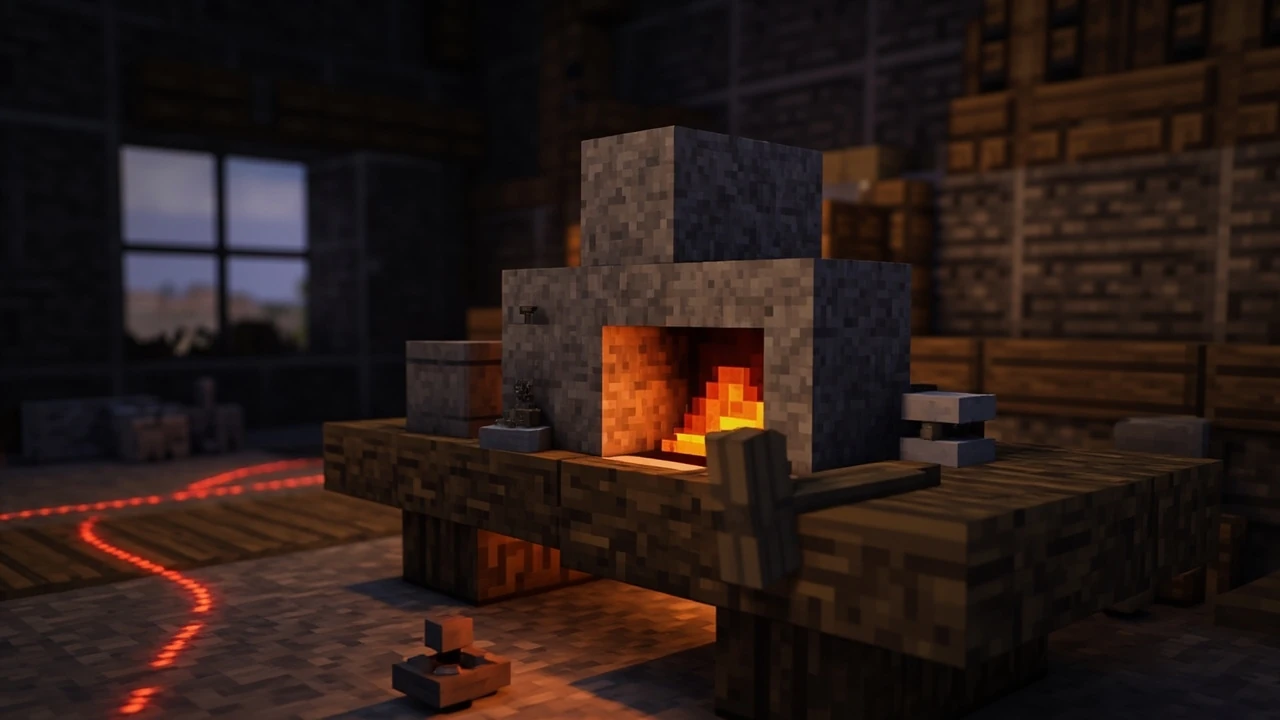

Smooth stone Minecraft: where it comes from and what it is good for
Smooth stone is one of the few Minecraft blocks that has to be smelted twice before it exists. That extra step is the reason it feels more deliberate than cobblestone or regular stone, and it is also the reason the block is treated as a step up in building projects. Smooth stone is the material that lets a furnace keep its contents when picked back up, the surface under most redstone contraptions worth keeping, and the texture that builders pick when regular stone is too noisy. Knowing where it comes from, how the smelting chain works, and where the extra effort stops paying off is what separates a stockpile of unused grey blocks from a workshop that runs cleanly.
This article walks through the crafting chain from cobblestone to smooth stone, the natural generation rules that decide whether you will ever find the block in the wild, the recipes that consume it, and the design choices that turn a plain grey texture into a structural one. It also covers how smooth stone behaves around pistons, what it costs to maintain a smelting array, and a few patterns that have become common in community survival builds.
What smooth stone is in the game state
Smooth stone is a solid block with an even grey texture on every face. It sits in the same material family as cobblestone and regular stone, but it behaves differently when mined and when used under machines. The block is defined by its mining hardness, its resistance to explosions, and the fact that it can be picked up with any pickaxe without losing its identity. That last property is what separates it from regular stone, which drops cobblestone the moment a pickaxe without Silk Touch touches it.
Technically, smooth stone is a fully opaque block. It does not emit light, it cannot be moved by pistons in most situations, and its hardness and blast resistance match the rest of the stone family. None of that gives it a defensive edge over cobblestone. What it does give is consistency: the texture never changes, the block never reverts, and any item crafted from it inherits that predictability.
How smooth stone differs from related stone blocks
The smooth stone family in current Java and Bedrock editions is larger than it looks. Each variant exists for a specific reason, and the differences matter when choosing a building texture or a machine base.
- Cobblestone: the raw, uneven block that drops from regular stone and generates in dungeons, mineshafts, and villages. It is the cheapest stone block to gather and the busiest to look at.
- Stone: the result of smelting cobblestone. It looks similar to smooth stone but drops cobblestone when mined with a regular pickaxe.
- Smooth stone: stone that has been smelted a second time. It keeps its identity when mined and provides the flat surface used in many redstone and piston builds.
- Stone bricks, mossy stone bricks, cracked stone bricks, and chiseled stone bricks: the decorative family that shares the stonecutter and crafting recipes with smooth stone but serves a different role in builds.
- Polished andesite, diorite, and granite: parallel “smelted stone” results for the three stone variants generated in the overworld, each with its own texture and recipe chain.
The shared trait across all of these is the “smelt or cut again” pattern. The game repeatedly rewards the player for putting in an extra processing step in exchange for a cleaner, more predictable block.
The crafting chain from cobblestone to smooth stone
The recipe is short, but the time cost is real. A single smooth stone block requires two furnace operations, two units of fuel, and one raw cobblestone. The chain is worth understanding step by step because the same process unlocks several other useful blocks along the way.
Step 1: mine cobblestone
Cobblestone drops whenever a stone block is mined without a Silk Touch pickaxe, and it is also the default block for many generated structures. A wooden pickaxe is enough to start the chain. The game does not reward a better tool at this stage, but it does not penalize one either, so if you are already carrying a stone pickaxe, mining goes faster and the tool lasts long enough to keep going.
Step 2: smelt cobblestone into stone
Place the cobblestone in the top slot of a furnace, add a fuel source in the bottom slot, and wait for the arrow to fill. Coal, charcoal, wooden planks, sticks, lava buckets, and several other items all work. The result is regular stone, an item that looks similar to smooth stone but behaves differently when mined. This first smelt also unlocks the stonecutter, stone bricks, and the polished stone variants once a crafting table is available.
Step 3: smelt stone into smooth stone
Take the stone from step 2 and place it back into a furnace. With the same fuel, you get one smooth stone block for each stone block. The smelting time and fuel cost are identical to the first pass, which is why a multi-furnace array is the most efficient way to scale up production. The resulting smooth stone can be picked up and stored without losing its identity, so a misplaced block does not mean another trip to the furnace.
Why the second smelt exists at all
The second smelt is a deliberate pacing choice. The game uses it to gate the smooth stone slab, the blast furnace, and several redstone-friendly surfaces behind a small time investment. That pacing is also why smooth stone is treated as a step up from regular stone in building projects, even though the two blocks are equally strong in practice.
Natural generation: why most players will not find smooth stone in the wild
Smooth stone has one of the smallest natural footprints in the game. It does not appear as part of a biome, does not spawn in ravines, mineshafts, or strongholds, and is not present in the deep dark or ancient cities. According to the Minecraft Smooth Stone reference page on IGN, smooth stone only appears inside a butcher’s house in certain plains villages, and even there the quantity is small.
That limited generation is why most experienced players skip exploration and go straight to a smelting array. The block is not rare the way deepslate diamonds or ancient debris are rare. It is rare because the game rarely places it, which is a deliberate design choice. The smelting chain exists precisely because finding it naturally is unreliable.
Other sources worth knowing
Wandering traders will occasionally sell smooth stone in small quantities, and the block can be pulled from a creative-mode inventory on servers that allow it. None of these methods scale to a serious build, but they help when only a handful of blocks are needed.
Smelting efficiency: fuel, speed, and the case for multiple furnaces
The bottleneck in any smooth stone operation is furnace throughput, not raw cobblestone. A single furnace smelts one block at a time, and each smooth stone block requires two smelts. The fastest practical setup is a row of furnaces fed by a hopper line and a single large fuel chest, with lava buckets as the fuel source. Lava provides 100 smelts per bucket, which keeps operator interaction low once the array is running.
Fuel options for a smooth stone array
Choosing the right fuel affects both speed and how often the array needs a refill. Each fuel has a different smelt count, and the right choice depends on how much wood, coal, or lava is on hand.
- Wooden planks: a low-cost, easily renewable fuel for early-game players. Best used in a small furnace array while a coal supply is built up.
- Charcoal: produced by smelting wooden logs in a furnace. It is renewable and slightly more efficient than planks, but it still requires a steady log supply.
- Coal: the standard fuel for mid-game furnace arrays. It is fast, predictable, and stacks well in hopper-fed systems.
- Lava buckets: the most efficient fuel for large arrays. Each bucket smelts 100 items, and a single lava source can be bottled indefinitely with a bucket and a cauldron.
- Blast furnace: relevant only for smelting ores, not for the smooth stone chain. The blast furnace accepts cobblestone but not stone, so it cannot be used to make smooth stone and should not be considered for this task.
How many furnaces are actually needed
For a typical survival base, a bank of four to eight furnaces is enough to produce smooth stone faster than most building projects can use it. A four-furnace array fed by one chest of cobblestone and one lava bucket will run for an extended period without intervention. Larger arrays make sense for server-scale building projects or for players preparing a large redstone farm, but beyond eight furnaces, the bottleneck shifts from smelting time to hopper throughput and chunk loading.
Recipes and machines that depend on smooth stone
Smooth stone is a surprisingly central crafting ingredient. It appears in the recipe for the blast furnace, the smoker, the smooth stone slab, and several other items the player cannot easily skip. Understanding which recipes consume smooth stone helps plan smelting output before starting a long array.
Blast furnace
The blast furnace is a workstation that smelts ores at twice the speed of a regular furnace, at the cost of not being able to smelt food. Its recipe requires three smooth stone blocks, five iron ingots, and a furnace. The smooth stone is what gives the blast furnace its sturdier look and its resistance to being picked up empty. For anyone working with iron or gold ore in volume, the blast furnace pays back the smooth stone investment quickly.
Smoker
The smoker is the food-focused cousin of the blast furnace. It cooks food at twice the speed of a regular furnace and uses the same slot arrangement. Its recipe mirrors the blast furnace, with smooth stone standing in for the structural blocks. Building both workstations early turns a survival base into a much more efficient operation.
Smooth stone slab
The smooth stone slab is the half-height version of the block. It uses three smooth stone blocks in a row in a crafting table and produces six slabs, which makes it the most slab-efficient stone recipe in the game. Smooth stone slabs are popular in modern-style builds and in redstone floors where a thinner profile is needed.
Other recipes that include smooth stone
A few other crafting recipes and structure requirements depend on smooth stone, although most players encounter them less often than the blast furnace and smoker. Keeping a small reserve prevents a sudden crafting stall in the middle of a project.
- Stonecutter crafting recipe in some datapacks and modded versions, where smooth stone is treated as a base for carved variants.
- Decorative blocks in building packs and texture packs that add smooth stone to recipe chains for slabs, stairs, and walls.
- Custom structures on servers and adventure maps, where smooth stone is used as a marker block for safe building surfaces.
Smooth stone as a redstone and piston base
Redstone builds reward flat, predictable surfaces, and smooth stone is the most reliable such surface that vanilla Minecraft provides. Pistons, repeaters, comparators, and rails all sit cleanly on smooth stone, and the block does not interfere with signal propagation. Cobblestone works too, but its noisy texture is harder on the eyes during long design sessions, and regular stone has the mining-side issue that discourages reorganisation.
Why designers prefer smooth stone over cobblestone in redstone floors
The texture difference is mostly aesthetic, but a few mechanics do change. A smooth stone block is slightly less prone to distracting shadows under specific lighting setups, and it does not drop experience orbs the way a Silk Touch cobblestone can in some versions. The practical benefit is that a smooth stone floor can be reconfigured without leaving a trail of cobblestone behind, which keeps the workshop readable.
Pistons, slime blocks, and moving floors
When a piston pushes a smooth stone block, the block behaves like any other solid: it moves if the space is free, and it refuses to move if the destination is blocked. The only meaningful interaction is with slime blocks and honey blocks, which inherit their movement rules from the blocks they are attached to. For flying machines, a smooth stone block surrounded by slime blocks moves cleanly and does not slow the array the way an obsidian-adjacent build can.
Building and design choices with smooth stone
Outside of machines, smooth stone is one of the most flexible building textures in the game. It is grey, flat, and visually quiet, which makes it a strong choice for floors, walls, and ceilings in modern, brutalist, or industrial builds. The same qualities make it a poor choice for organic or rustic styles, where cobblestone, mossy stone, and stone bricks carry more character.
Texture pairing rules that hold up in real builds
Pairing smooth stone with the right supporting blocks is what separates a flat grey box from a finished structure. The following pairs are the ones that experienced builders return to most often, because they survive changes in lighting and scale.
- Smooth stone plus oak planks plus glass: a clean, modern interior that works in survival builds and on servers.
- Smooth stone plus stone bricks plus chiseled stone bricks: a high-contrast combination that emphasises the difference between flat and textured surfaces.
- Smooth stone slabs plus spruce planks plus lanterns: a compact medieval style that uses the half-height of the slab to break up floor planes.
- Smooth stone plus polished andesite plus polished diorite: a soft, layered greyscale palette that hides uneven lighting in large halls.
When to avoid smooth stone in a build
Smooth stone is not always the right call. In a build that needs to feel warm, lived-in, or overgrown, the flat grey texture can read as cold or unfinished. The same is true for any project that leans on decorative blocks, banners, or patterned walls, where smooth stone acts as a backing texture rather than a focal one. Recognising when the block is supporting the build and when it is competing with it is the skill that keeps large projects from feeling monotonous.
Comparison: smooth stone, stone bricks, and polished andesite
Players often ask which “smooth” stone block to use as a default for a new build. The honest answer depends on what the surface needs to communicate, how much smelting time is available, and whether the block will sit under redstone or pistons. The table below compares the three most common choices on the criteria that usually matter in a survival or small-server build.
| Criterion | Smooth stone | Stone bricks | Polished andesite |
|---|---|---|---|
| Crafting cost per block | 1 cobblestone and 2 fuel | 4 stone (each needs 1 cobblestone and 1 fuel) | 4 andesite (each needs 1 cobblestone and 1 fuel) and no second smelt |
| Mining behaviour | Stays smooth when picked up | Stays as stone brick when picked up | Stays polished when picked up |
| Visual texture | Flat, even grey | Defined mortar lines | Subtle, slightly noisy light grey |
| Redstone friendliness | Excellent, common piston base | Good, but visually loud | Good, similar to smooth stone |
| Best role in a build | Floors, modern walls, machine bases | Accent walls, foundations, exteriors | Bright interior surfaces, contrast with darker blocks |
The table is not a verdict. Smooth stone is the cheapest of the three to produce in volume, stone bricks are the most decorative, and polished andesite is the brightest. Picking a default is less important than picking the right block for each surface, and the right block usually comes from a small palette of two or three of these greys.
Recipes, fuel, and time at a glance
The numbers below are the ones most players want when planning a smelting array. They come straight from the smelting chain described in the previous sections and assume a standard furnace with no efficiency enchantments.
| Step | Input | Fuel per unit | Output | Time per unit |
|---|---|---|---|---|
| Mine cobblestone | Stone block (any pickaxe) | None | Cobblestone | About 0.75 seconds |
| Smelt cobblestone | Cobblestone in furnace | 1 coal or equivalent | Stone | 10 seconds |
| Smelt stone | Stone in furnace | 1 coal or equivalent | Smooth stone | 10 seconds |
| Craft smooth stone slab | 3 smooth stone | None | 6 smooth stone slabs | Instant |
| Craft blast furnace | 3 smooth stone, 5 iron ingots, 1 furnace | None | 1 blast furnace | Instant |
| Craft smoker | 4 oak logs, 1 furnace | None | 1 smoker | Instant |
Two details from the table are worth keeping in mind. First, the smelter time is the same for both passes, so a smooth stone block always costs roughly 20 seconds of furnace time and two units of fuel. Second, the slab recipe triples the surface area of the input, which is why most builders who plan large floors smelt stone first and slab it only when they know the exact footprint.
Troubleshooting common smooth stone problems
Most smooth stone problems are symptoms of a setup issue rather than a fault of the block itself. The cases below are the ones that come up most often in survival and small-server play.
Problem: the furnace produces regular stone, not smooth stone
This almost always means the input was cobblestone rather than stone. The game does not smelt smooth stone directly from cobblestone in a single step. Run the cobblestone through the furnace once, then put the resulting stone through a second time. If the input is already stone and the output is still regular stone, the input slot is contaminated or the wrong block type is loaded.
Problem: the smelting array runs out of fuel mid-batch
Furnace arrays fed by hoppers will quietly stop when the fuel runs out, leaving half-smelted items inside. The fix is to over-supply the fuel chest rather than top it up. A single lava bucket is enough to keep a small array running through an entire batch, and a lava-filled cauldron can be bottled for an indefinite supply.
Problem: smooth stone turns into cobblestone when mined
This is impossible in vanilla Java and Bedrock editions. If a block thought to be smooth stone is dropping cobblestone, the block is regular stone, not smooth stone. Use the crafting table recipe or the stonecutter output as a reference texture, and double-check the input to the smelting array.
Problem: the build feels too grey
It is rarely the smooth stone itself that is the problem. A flat grey block needs at least one contrast element on every surface or the build will read as unfinished. Add a single warm material (oak, spruce, or copper) and one bright texture (lanterns, sea lanterns, or glazed terracotta) to break the surface, and the build will feel much more deliberate.
Design patterns from community builds
A few smooth stone patterns appear often enough in shared survival builds to count as community conventions. None of them are required, but they are useful starting points for a player who is stuck on how to use the block at scale.
Pattern: a layered grey interior
The most common smooth stone pattern in modern survival builds pairs a smooth stone floor with stone brick walls, polished andesite ceilings, and oak or spruce trim. The eye reads the floor as a stable base, the walls as a structural frame, and the ceiling as a softer texture that prevents the room from feeling like a bunker. Adding two or three lanterns completes the layering without breaking the palette.
Pattern: a redstone workshop floor
For a workshop floor that needs to host repeaters, comparators, and pistons, the standard community pattern is a smooth stone surface with a single block of polished deepslate or polished andesite marking each redstone component. The smooth stone absorbs visual noise, while the polished block provides a clean “this is the device” cue. Players who have used this pattern report that it is much easier to debug a complex redstone circuit when each device is bordered by a different block.
Pattern: a brutalist exterior
Smooth stone is one of the few vanilla blocks that scales well to large exterior walls without looking patchy. A common brutalist pattern uses smooth stone for the primary wall, stone bricks for the foundation, and chiseled stone bricks for windows and door frames. The result is a building that reads as solid from a distance and as detailed up close, which is the visual goal of most brutalist designs.
Optimising a smooth stone build for performance and safety
On multiplayer servers and large singleplayer worlds, the choice of building block affects more than the look of the build. Smooth stone is, in most respects, a low-cost block: it does not emit light, does not tick, and does not interact with the redstone update queue except where it is a redstone component. That makes it safer than many alternatives, but not free.
Block update load
Every redstone component on a smooth stone floor contributes to the block update count for the chunk. The block itself does not add updates, but the components on it do. If a build is hitting server lag, the first thing to check is the number of redstone components, not the number of smooth stone blocks. A simple rearrangement of pistons and repeaters can drop the update load more than any change to the floor texture.
Lighting and mob spawning
Smooth stone does not emit light, so any enclosed space built from it still needs torches, lanterns, or another light source to suppress mob spawning. The common mistake is to assume that a stone block is safe because mobs cannot spawn on it, then leave a roofed area without any light. The result is a slow trickle of zombies and skeletons in a build the player thought was secure.
Storage and inventory planning
For long projects, a dedicated shulker box of smooth stone is a useful tool. A single shulker box holds 1,728 smooth stone blocks, which is enough to floor a medium-sized hall or to repair a workshop floor after several design iterations. Keeping the shulker box in a known chest makes it easier to refill from a furnace array without leaving the build site.
Frequently asked questions
Can a blast furnace be used to make smooth stone?
No. A blast furnace accepts cobblestone as fuel, but it does not accept stone as an input, so it cannot perform the second smelt that turns stone into smooth stone. To produce smooth stone, at least one regular furnace and an additional smelt on the stone output are required. For high-volume production, a row of regular furnaces is the right tool, not a blast furnace.
How long does it take to smelt one smooth stone block?
Each smelt in a regular furnace takes 10 seconds with most fuel sources, so a single smooth stone block requires about 20 seconds of total furnace time. The fuel cost is one item per smelt for coal, charcoal, planks, or sticks. Lava buckets provide 100 smelts per bucket, which works out to 50 smooth stone blocks per bucket of lava.
Is smooth stone blast resistant?
Smooth stone has the same blast resistance as regular stone and stone bricks, so it is moderately resistant to explosions but not invincible. Creepers, end crystals, and TNT can still destroy smooth stone, and the only blocks that meaningfully resist a charged creeper or a large explosion are obsidian, ancient debris, netherite blocks, and crying obsidian. Smooth stone is best treated as a structural material, not a defensive one.
Can smooth stone be moved by pistons?
Smooth stone is a normal solid block and can be pushed or pulled by pistons as long as the destination is a free space. It does not stick to slime blocks any more or less than any other block of the same size, and it does not refuse to be moved. A piston array of smooth stone blocks surrounded by slime blocks is a standard pattern for moving floors in flying machines.
What is the difference between smooth stone and stone bricks?
Stone bricks are a separate decorative block that requires stone as a crafting ingredient, while smooth stone requires an extra smelting step on stone. The textures are different (stone bricks have visible mortar lines), the crafting cost is higher for stone bricks, and the two blocks serve different roles in a build. Stone bricks are typically used for walls and foundations, while smooth stone is used for floors, ceilings, and machine bases.
Does smooth stone generate in any structures besides villages?
In current vanilla Java and Bedrock editions, smooth stone generates only inside plains village butcher’s houses. It does not appear in mineshafts, strongholds, woodland mansions, ancient cities, or trial chambers. The limited generation is the reason the crafting chain, rather than exploration, is the practical way to obtain smooth stone in survival.
Can smooth stone be used as a beacon base?
Yes. Smooth stone is a valid material for building a beacon pyramid, and it counts as a complete pyramid when stacked in the standard shape. Using smooth stone for a beacon base is a common choice in modern-style builds because the texture is clean and the block is cheap to produce in volume. The beacon itself does not need to be placed on smooth stone; any pyramid of iron, gold, emerald, diamond, or netherite blocks, plus smooth stone, will activate it.
Is smooth stone renewable in survival?
Yes. Cobblestone is renewable through mob farms, generators, and the slow but reliable mining of stone, and the smelting chain turns cobblestone into smooth stone indefinitely. There is no finite supply of smooth stone in survival, and the only constraint is the time spent smelting and the fuel used. For most players, smooth stone is one of the easier “renewable” blocks to maintain once a furnace array is set up.
What is the best use for a small smooth stone reserve?
A small reserve of smooth stone is best spent on a blast furnace, a smoker, and a stack of smooth stone slabs. Those three items cover the most common workstation needs and give a clean, modern surface for small redstone or building projects. Once those are crafted, any further smooth stone is best stored in a shulker box until a larger project calls for it.
Smooth stone rewards the player who is willing to spend a few extra minutes at a furnace row. The block does not announce itself the way a diamond tool or a beacon does, but it quietly underpins the workstations, the redstone floors, and the modern interiors that most players build once they move past the early game. Treat it as a structural material, smelt in volume, and the rest of the design tends to follow.
Leave a Reply