

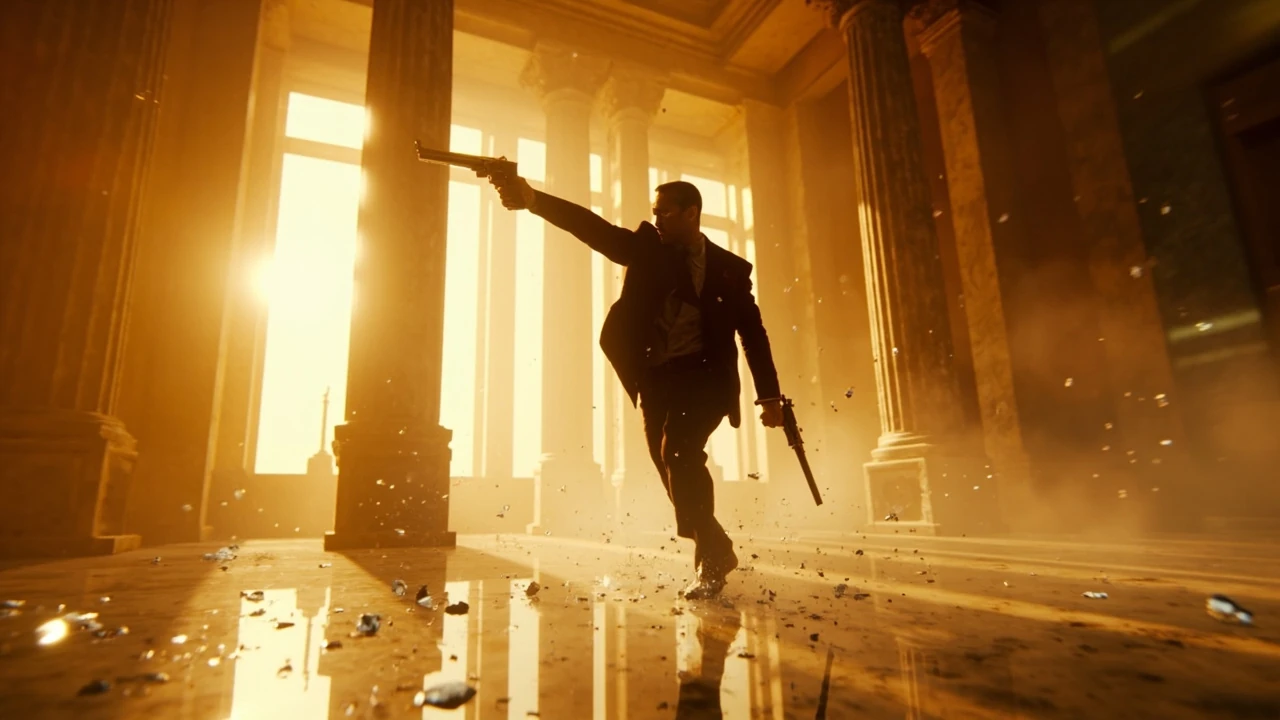

John Wick 5 game development: what a fifth film actually changes for an adaptation
A fifth John Wick film is officially in motion at Lionsgate, and the franchise’s owner has already signaled interest in expanding the property into interactive media. That combination is the most important fact for anyone tracking john wick 5 from a game development angle. A new feature film is not, by itself, a game project. What it does is reset the commercial window in which a studio could pitch, scope, and ship a john wick 5 adaptation, because film and streaming hits of this scale usually move licensing, marketing budgets, and creative availability at the same time.
The reference point for studios is the franchise’s previous interaction with games. Boreal Tenebrae and Good Shepherd Entertainment released John Wick Hex in 2019, a tactical turn-based strategy game built around the films’ gun-fu combat. The 2014 film that started the series is documented on the John Wick Wikipedia entry, and reporting on Lionsgate’s broader interactive strategy has appeared in outlets such as The Verge’s coverage of Lionsgate’s game plans, which provides useful background for this point. Those two data points frame the rest of this article.
This piece is written for game developers, technical artists, producers, and studio leads who need a sober read on what a confirmed fifth film means for an adaptation, where the realistic design space is, and which production decisions matter before a single asset is built. It is not a rumor roundup. It is a working briefing on the constraints a real john wick 5 project would have to clear.
What is confirmed about a john wick 5 video game
As of the current date, the confirmed facts are narrow and the rest is informed inference. Listing them clearly matters because the difference between an announced game and a market-friendly franchise is the difference between a development plan and a pitch deck.
- A fifth John Wick feature film, sometimes written as John Wick 5, is in active development at Lionsgate, with Chad Stahelski attached to direct and Keanu Reeves attached to star in public statements from the company.
- Lionsgate executives have publicly discussed the franchise’s interactive potential on earnings calls and in trade press, describing video games as part of the long-term john wick 5 franchise strategy rather than as a one-off product.
- No studio, no engine, no platform, no release window, and no budget has been publicly confirmed for a dedicated john wick 5 video game. Reporting on the franchise’s interactive ambitions has framed the opportunity, not the project.
- The previous licensed game, John Wick Hex, was developed by Boreal Tenebrae and published by Good Shepherd Entertainment, and remains the only shipped reference point for what Lionsgate has actually approved in this IP.
What that means for a working team is that a john wick 5 game today is a licensing and design exercise, not a production project. The first decisions a real team would have to make are who holds the rights, who controls the story, and what counts as canon for the period the game covers. None of those answers are settled in public.
Why the film matters more than the game in 2026
Studios often treat a film as a marketing event and a game as a product, but for an action franchise like this the order of operations is reversed. The film sets the canon, the cast, the costume language, the level design vocabulary, and the brand permissions. The game has to be designed to exist inside that box.
The film’s release pattern sets the demand curve
John Wick (2014), Chapter 2 (2017), Chapter 3 – Parabellum (2019), and Chapter 4 (2023) each expanded the world in roughly the same direction: more rules, more factions, more international settings, and more elaborate combat choreography. A confirmed john wick 5 entry, if it follows the same cadence, will land several years after Chapter 4 and bring the Continental mythology and the High Table politics into a new setting. That window is also the window in which an adaptation would be pitched, greenlit, and shipped if it is going to ride the film’s marketing wave rather than fight it.
Brand owners are pushing harder into games
Major film studios have publicly committed to treating their IP libraries as cross-platform franchises, with games as a core revenue line rather than a marketing tie-in. Lionsgate’s own statements on a john wick 5 game sit inside that broader pattern. The interesting detail is not whether the company wants a game. It is what kind of game the company believes it can fund and protect alongside the film’s release schedule.
Player intent is action-first, not narrative-first
Search and community behavior around the franchise skews heavily toward combat, gunplay, and the look of the films. That has direct design consequences. A john wick 5 game has to feel like the choreography of the films, not just the plot of them. Cinematic third-person shooters, tactical strategy games, and stylized action RPGs all live inside that envelope, but a narrative adventure or a story-led walking sim would be working against the audience’s expectations.
What a john wick 5 game could realistically be
There is no shortage of concepts a pitch deck could include. The useful exercise is to filter them by what the IP actually supports and what studios are set up to deliver. The table below maps the most credible design directions to the franchise’s established language and to the production realities a team would face.
| Design direction | Fit with john wick 5 IP | Production reality for a licensed team | Risk if scope creeps |
|---|---|---|---|
| Cinematic third-person action | High. Mirrors the films’ camera language and combat style. | Demands mocap, stunt coordination, animation budget, and combat AI. | Animation cost can dominate the schedule; combat feel becomes the single point of failure. |
| Top-down or isometric action | High. Reminds players of John Wick Hex without copying it. | Smaller art and animation surface, easier certification on console and PC. | Risk of feeling like a derivative of the prior licensed game if systems are not differentiated. |
| Tactical turn-based strategy | Medium. Hex already used this slot and was well received critically. | Lower asset cost, but small total addressable market for licensed tactics. | Sequel fatigue from a niche base that has already been served. |
| Live-service action RPG | Low to medium. Genre is crowded and timelines are long. | High team size, high server cost, multi-year roadmap. | Live ops risk compounds if the film release slips or changes canon. |
| VR first-person combat | Medium. Strong novelty, weak install base for licensed AA IPs. | Comfort, motion sickness, and platform certification overhead. | Limited reach and limited updateability if reception is soft. |
The two directions with the strongest combined IP fit and production realism are a cinematic third-person action game and an isometric action game. The others are viable in the right hands but require a bigger commercial case.
Designing combat that actually feels like john wick 5
Combat is the franchise’s signature, and it is also the place where licensed games most often fail. Players do not want generic cover shooters with a John Wick skin. They want the close-quarters gun-fu, the focus mechanics, and the willingness to use the environment as a weapon that the films have made iconic. Designing that well is harder than it looks.
Gun-fu as a system, not a flourish
The films treat firearm use as a martial art. A john wick 5 game has to encode that as systems, not as animation. Useful primitives include a stance system that switches between long-range precision, close-range two-gun, and melee-grappling, a focus meter that gates headshot damage and disarm attempts, and an enemy AI that actually attempts to flank, call for help, and use cover rather than rushing the player in waves.
Animation as a production line, not a hero asset
Gun-fu combat cannot live on a few mocapped scenes. It needs an animation pipeline that can produce hundreds of contextual reactions, disarm moves, environmental finishers, and reload variants without breaking frame timing. That pipeline, more than the combat design document, is what determines whether a project ships on time.
AI as the second protagonist
John For additional context, Wick’s choreography depends on a small number of highly competent enemies. A licensed game that spawns twenty-five mindless grunts per encounter destroys the fiction. A john wick 5 game should be designed around encounter budgets, not bullet sponges, with squad-level coordination, distinct enemy archetypes, and a difficulty curve that punishes sloppy play rather than adding hit points.
Building the world without a level design cliché
Hotels, nightclubs, and museums appear in every action game. The franchise has its own specific architectural vocabulary, and a working team should treat it as content, not as a checklist.
- The Continental: the assassins’ hotel, with its neutral-ground rules, its back rooms, and its armory. A defensible hub level, a tutorial space, and a recurring set piece all live inside the same building if it is built with enough interior variation.
- The High Table: a set of interiors and exteriors that signal institutional power, including cathedrals, libraries, council chambers, and rooftop approaches. These spaces are useful for stealth and for boss-fight framing.
- Service corridors and back-of-house spaces: the franchise consistently contrasts opulent front-of-house with utilitarian service areas. That contrast is a free level design tool, because it lets designers alternate player fantasy and player tension without changing the art set.
- Urban exterior combat zones: hotel districts, train stations, and street markets that allow ranged combat and vehicle interaction without crossing into open-world scope.
The practical lesson is to build two or three of these spaces at high quality rather than ten at low quality. The franchise is small in world terms and huge in atmosphere terms, and that ratio is what an adaptation has to honor.
Tech and engine choices a john wick 5 project has to clear
Engine choice is downstream of design, not the other way around. But for a project of this profile, the engine decision has to be made early because the licensed combat style depends on specific rendering, animation, and physics features.
Animation stack
Gun-fu requires layered animation: locomotion, weapon handling, target acquisition, and reaction layers all running at the same time. A john wick 5 project needs an animation system that can blend procedural and authored animation, support per-bone hit reactions, and run reliably on the minimum spec target without animation drift.
Physics and destruction
The films use environment as a weapon: chairs, glass, doors, and props. A licensed game has to support at least staged destruction and interaction with mid-poly props. Real-time global destruction is not necessary, but designers need a system for breakable cover, throwable props, and reactive lighting on shattered glass.
Camera and framing
The franchise’s signature look depends on slow-motion during focus, tight over-the-shoulder framing during close combat, and pulled-back wide shots for ranged exchanges. A cinematic third-person action game built around the IP should plan for a custom camera director that can read combat state and choose framing, rather than relying on a single player-controlled camera behavior.
Networking, if the project is co-op or PvP
Any co-op or PvP layer has to treat authority and anti-cheat seriously. A licensed action game with a PvP mode is a long-term service commitment, not a launch feature, and the cost of a competent PvP netcode has to be modeled into the budget from day one. A purely single-player or shared-world PvE design avoids that cost but introduces its own content-throughput problem.
Production decisions that decide whether the project ships
Most licensed games do not fail because the IP is wrong. They fail because the production plan does not respect the constraints. A john wick 5 project would face the same pattern, and the production decisions that have to be locked early are not creative ones.
Scope, vertical slice, and review cadence
Licensed projects are usually reviewed at three gates: pitch, vertical slice, and full production greenlight. Each gate has a deliverable, and each deliverable has to be designed so that a negative review produces a useful learning, not a full restart. A john wick 5 team should plan the vertical slice around one combat encounter, one hub level, and one cinematic beat, all of which exercise the same combat and animation systems.
Milestones and acceptance criteria
Acceptance criteria are the contract between the studio and the IP holder. For a licensed action game, useful criteria include combat feel ratings, animation count thresholds, framerate targets on minimum spec, certification pass rates, and accessibility coverage. These are not paperwork. They are how a team defends its schedule when the IP holder asks for revisions.
Risk register and change control
Canon changes are a real risk for any project tied to an active film franchise. A john wick 5 game would need a written change-control process that specifies who can change script beats, who can change level geography, and who can change character design. Without that document, a single script revision can ripple into months of rework.
Comparing a john wick 5 game to its closest neighbors
The licensed action market is small, and the design choices that distinguish a project usually come from explicit comparisons with adjacent games. The table below compares the most relevant neighbors a john wick 5 team would benchmark against.
| Reference title | Closest design lesson | What a john wick 5 game should take | What a john wick 5 game should avoid |
|---|---|---|---|
| John Wick Hex (2019) | Proves there is an audience for a tactics-flavored adaptation. | The hexagonal grid combat feel, the boss-encounter design, the respect for the IP’s tone. | The risk of feeling like a smaller follow-up if the new game uses the same camera and pacing. |
| Sifu (2022) | Single-character martial-arts action with strong aging and death mechanics. | Disciplined encounter design, environmental finishers, strong melee feel. | Aging or roguelike structure that does not match the franchise’s plot. |
| Max Payne 3 (2012) | Cinematic third-person shooter with bullet-time and slow-motion focus. | Bullet-time as a focus mechanic, cinematic framing, tight level structure. | Long cutscenes that break combat pacing. |
| Uncharted 4 (2016) | AAA cinematic action with strong animation and traversal. | Animation quality bar, environmental traversal, set-piece design vocabulary. | Open-world scope that the franchise does not need. |
| Hitman 3 (2021) | Sandbox stealth in curated social spaces. | The Continental as a sandbox hub, disguises and contracts, social stealth. | Full sandbox scope at launch and the live-service expectations that come with it. |
The pattern is clear. A john wick 5 game should pick a small number of high-quality set pieces, build a focused combat system around gun-fu, and treat the franchise’s locations as content rather than as a checklist.
What the IP holder actually controls
The reason licensed projects are hard is that the IP holder controls more than people expect. Understanding that control is part of the work.
- Story canon: the IP holder has the final say on which characters appear, which factions are active, and which events are referenced. Designers should plan for change rather than negotiate against it.
- Character likeness: realistic depictions of the lead actor require approval, and stylized depictions still require a likeness brief. Building an original protagonist is the cleanest way to avoid the bottleneck.
- Tone and rating: the franchise’s tone is well established, and a project that drifts too far into either family-friendly territory or grimdark territory will be sent back for revision.
- Brand assets: music, costume, and prop references have to be sourced from approved libraries. A team should build an asset audit early and assign an owner to keep it current.
- Marketing and announcement: the IP holder usually controls the announcement date, the first trailer, and the press cycle. A studio that has not aligned on that calendar will lose a marketing window.
The professional move is to build a single point of contact with the IP holder, define a change-control process in writing, and then defend the production schedule using that document.
Live operations, if the project goes that way
Not every licensed action game is a live service, and not every franchise should be. But if a john wick 5 project did go live-ops, the decisions below are the ones that would have to be made before launch.
- Content cadence: a seasonal content schedule has to be defined before launch, with at least one full season planned in detail. Free content can subsidize paid content only if the player base is large enough to support it.
- Economy design: cosmetic microtransactions are the lowest-risk monetization model, but only if the cosmetic system is built into the engine, not bolted on. Designing the economy after the game is in soft launch is a common cause of post-launch rework.
- Server architecture: a PvE live-ops game needs a backend that can scale with concurrent players and survive regional outages. Choosing the backend stack is a six-month decision that has to be made a year before launch.
- Moderation and safety: PvP or social spaces require moderation tooling, code of conduct enforcement, and reporting pipelines. These are not optional and they are not free.
- Sunset planning: every live service has a sunset. Writing the sunset plan before launch, and the data-archive plan alongside it, protects the studio when the decision is eventually made.
For a franchise that has not yet shipped a flagship game, live operations is a strategic option, not a default. A focused single-player john wick 5 game is the lower-risk path to a brand relationship, and live operations can come later if the relationship matures.
Accessibility, certification, and platform realities
Licensed games have to clear the same certification and platform rules as any other title, but the IP adds a layer of approval on top. The useful planning is to treat accessibility and certification as design constraints, not as finishing work.
Accessibility as a design input
Action games are a high-risk category for accessibility because combat difficulty is part of the fantasy. A john wick 5 project should plan for remappable controls, scalable difficulty modes, subtitle and caption support, and aim-assist options that respect the combat system rather than undermine it. None of these features are incompatible with a hardcore action design, and all of them are easier to add before the first vertical slice than after the first review.
Certification, from day one
Console and storefront certification are gate-driven processes with predictable deliverables. A studio that treats certification as a final-week task is a studio that misses its launch window. The discipline is to nominate a certification lead during pre-production, integrate the certification checklist into the build pipeline, and reject any change that would invalidate an existing submission.
Platform holder relationships
Platform holders are gatekeepers, but they are also partners. A licensed IP does not change the platform relationship, but it raises the stakes: a flagged submission costs more because the IP holder’s release calendar is in the same month. Building the relationship early and respecting the review process is cheaper than fighting it later.
Budget and team shape for a john wick 5 project
No public budget exists for a john wick 5 game, and any number published here would be invented. What is useful is the team shape that a project of this profile typically requires, and the cost categories that drive the schedule.
- Leadership: a producer who can interface with the IP holder, a design lead who can defend the combat system, and a technical director who can defend the engine and netcode decisions. These three roles are the spine of the project.
- Combat and animation: a combat designer, a lead animator, a mocap coordinator, and a small motion-capture pipeline. Combat and animation are usually the largest single line item in a licensed action game.
- Level design and art: a lead level designer, a lead environment artist, a lead lighting artist, and a small props team. The franchise’s set-piece look depends on tight art direction, not on a large art team.
- Engineering: a generalist engine team, an audio programmer, a tools programmer, and a backend programmer if the project is online. Tools are a common bottleneck and should be staffed before they become one.
- QA and certification: a QA lead, a certification lead, and a regression-testing strategy that includes the IP holder’s review cycles. QA is not a phase; it is a parallel function.
The honest framing is that a cinematic single-player john wick 5 game can be scoped for an experienced mid-sized studio, but it cannot be scoped for a small team without cutting one of the franchise’s signature systems.
How to evaluate a john wick 5 announcement when it happens
Eventually the IP holder will announce a game, and the announcement will be designed to look complete. The useful exercise is to read the announcement for what is missing rather than for what is present. A short checklist helps.
- Studio: who is developing it, and what have they shipped before in the same genre? A studio’s previous genre work is the strongest predictor of delivery.
- Engine: which engine is being used, and is the engine known to support the combat and animation features the franchise requires? Engine choice is a delivery risk indicator.
- Gameplay reveal: is there a real gameplay reveal at announcement, or only cinematic trailer content? The ratio of cinematic to gameplay is a quality-of-evidence signal.
- Release window: how tight is the release window to the film? Tight windows raise canon-change risk and certification risk.
- Platforms: which platforms are confirmed, and is the minimum spec realistic for the visual target? A multi-platform promise at AAA fidelity is a red flag.
- Post-launch plan: is there a roadmap, and does the roadmap match the studio’s prior post-launch patterns? A roadmap that is suspiciously large is a roadmap that will be cut.
The professional reader does not need the checklist to be excited about an announcement. The checklist is for the day after, when the project has to be evaluated against delivery risk.
What a john wick 5 game means for the broader licensed-action market
A successful john wick 5 game would do more than ship a title. It would give the licensed action category a recent commercial reference point, which would in turn unlock pitches for adjacent properties. A failed adaptation would do the opposite: it would harden the IP holder’s position against the next pitch, and it would push the category back toward safe bets.
For that reason, the stakes of the first serious john wick 5 project are higher than the project’s own commercial line. The team that ships it is also the team that sets the next five years of pitch meetings. That is not a reason to over-scope. It is a reason to under-promise and over-deliver, because the category’s appetite for a second try depends on how cleanly the first one closes.
Frequently asked questions
Is there a confirmed john wick 5 video game?
No dedicated john wick 5 video game has been publicly announced with a studio, engine, platform, or release window. Lionsgate has discussed the franchise’s interactive potential publicly, and a fifth film is in development, but a game project has not been confirmed at the time of writing.
Is a john wick 5 film actually happening?
Yes. A fifth John Wick feature film is in development at Lionsgate, with Chad Stahelski attached to direct and Keanu Reeves attached to star in public statements. The film’s release date has shifted publicly and should be verified against the studio’s most recent announcement before any production planning is built around it.
What is the most realistic design direction for a john wick 5 game?
A cinematic third-person action game is the most realistic direction because it best matches the franchise’s combat language, audience expectations, and existing reference games. An isometric action game is the second most realistic direction, with a smaller art and animation surface and a more predictable schedule.
Who owns the john wick 5 video game rights?
Lionsgate controls the John Wick film franchise and has publicly discussed video games as part of the long-term franchise plan. The specific interactive rights for a john wick 5 title would be defined in a license between Lionsgate and a development and publishing partner, and the structure of that deal shapes production control.
How does John Wick Hex affect a potential john wick 5 game?
John Wick Hex (2019) is the only shipped reference point for a John Wick licensed game. It proves the IP works as tactics, but it also means a new john wick 5 game should pick a different design direction so the two titles are not confused in the marketplace.
What engine would a john wick 5 game most likely use?
There is no confirmed engine for a john wick 5 project. Studios that have shipped cinematic third-person action games of comparable ambition have typically used Unreal Engine or proprietary engines, but engine choice is downstream of the studio that picks up the project.
How long would a john wick 5 game take to develop?
A focused single-player cinematic action game in this category typically takes between three and five years from greenlight to release, with a further year for certification and platform submission. Schedules shorten only when the team has prior genre experience and a strong vertical slice to defend.
Could a john wick 5 game be a live-service title?
It is possible, but live operations raise the cost, the team size, and the long-term commitment. A franchise that has not yet shipped a flagship game is usually better served by a focused single-player product, with live operations considered as a follow-up if the relationship matures.
What is the biggest production risk for a john wick 5 game?
Combat and animation are the largest single risk. The franchise’s identity depends on choreography, and a team that under-resources animation will not be able to deliver the look or the feel the IP demands, no matter how strong the rest of the game is.
What would change the outlook for a john wick 5 game?
Three things would change the outlook in a meaningful way: a public studio and engine announcement, a release window that lines up with the film, and a gameplay reveal that demonstrates the combat system rather than only the cinematic look. Until those three signals appear, the project is a licensing conversation, not a production plan.
For studios tracking john wick 5 as a real opportunity, the practical next step is to map the IP holder’s current licensing posture, identify a design direction that respects the franchise’s combat language, and prepare a vertical slice scope that can be defended in a single review. Everything else can wait for the announcement that has not yet happened.
Leave a Reply